
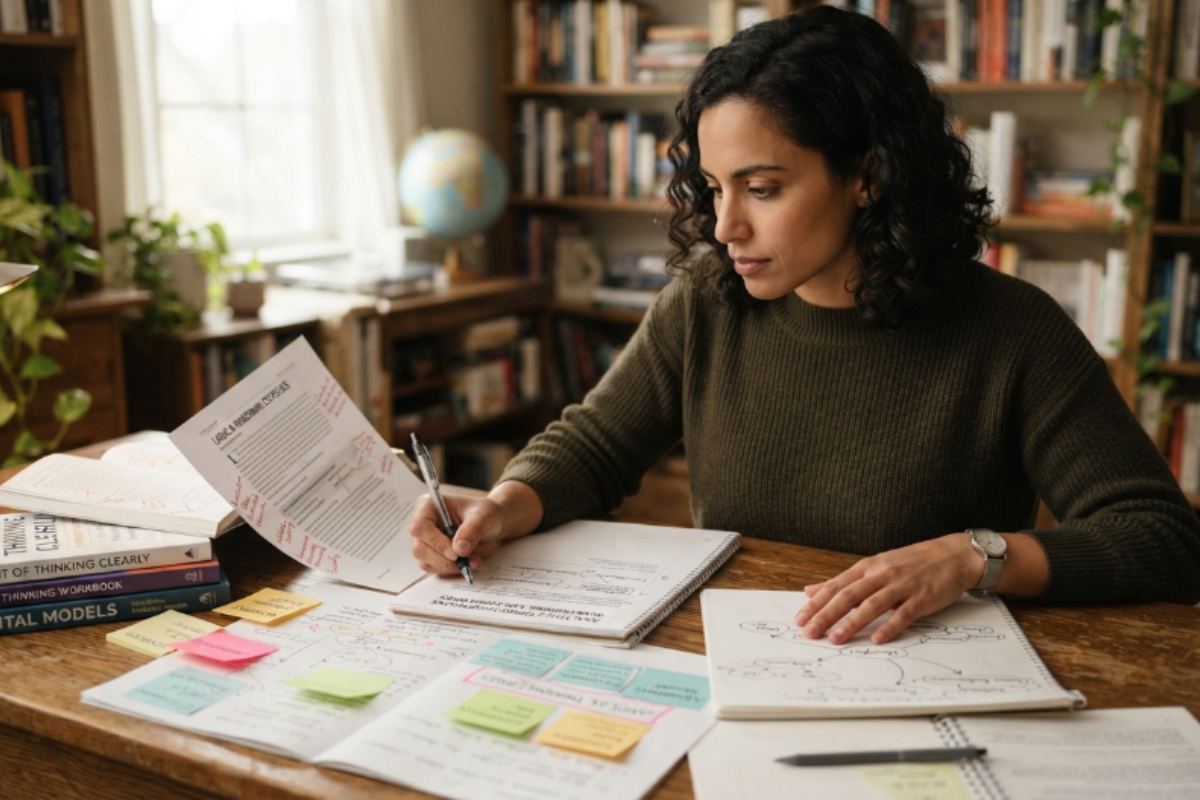
Critical thinking exercises are simple activities that help you slow down, examine information, question assumptions, and make better judgments. Critical thinking is not only something you learn by reading a definition. It becomes stronger when you practice it in real situations.
These exercises help you analyze ideas, test evidence, compare options, notice bias, solve problems, and explain why you believe something. Some take only a few minutes, while others work better when you spend more time on a problem.
Practical exercises can be more useful than theory alone because they make you actively use the skill. Reading about reasoning may help you understand the idea, but solving a problem or examining an argument requires you to apply it.
The critical thinking exercises below include questioning methods, evidence checks, logic activities, decision-making tasks, and reflection exercises. You can use them for study, work, everyday choices, online information, and personal problem-solving.
What Critical Thinking Exercises Actually Train?
Critical thinking combines several connected skills. Analytical thinking helps you break a complex situation into smaller parts. Logical reasoning helps you connect facts and ideas in a sensible way. Evaluating evidence helps you decide whether a claim is supported by strong information or only by opinion.
These exercises also train you to question assumptions, solve problems, make decisions, recognize bias, and consider other viewpoints. Good critical thinking does not mean distrusting everything. It means checking information fairly and being willing to adjust your conclusion when better evidence appears.
20 Critical Thinking Exercises You Can Practice
1. Ask “Why?” Five Times
Use this exercise to move beyond the first explanation and look for a deeper cause. Start with a problem, ask why it happened, then ask why again about each answer.
For example, if you are often late for work, you may first say, “I leave home too late.” Asking why again may reveal that you underestimate how long getting ready takes. This develops problem analysis and helps you address causes instead of symptoms.
2. Challenge One Assumption
Choose one belief behind a decision and ask whether it is actually supported. You may assume, for example, that a more expensive product must be better. Ask what evidence supports that idea and what would change if the assumption were false.
This exercise helps you separate what you know from what you have simply accepted.
3. Separate Facts From Opinions
Take a short statement, article, or conversation and identify which parts can be verified and which parts express judgment.
“The meeting lasted 90 minutes” is a factual claim that can be checked. “The meeting was a waste of time” is an opinion. This exercise helps you judge information more carefully.
4. Find the Evidence Behind a Claim
Choose a claim and ask what evidence supports it. Then decide whether the evidence is relevant, reliable, and strong enough.
If someone says a study method is “the best way to learn,” ask how that conclusion was reached, who was studied, and what it was compared with. This builds evidence-evaluation skills.
5. Think of Three Alternative Explanations
When something happens, your first explanation may not be the only one. Create at least three possibilities.
If a coworker does not reply to your message, they may be ignoring it, busy, or waiting for more information. Comparing alternatives can reduce quick judgment and improve reasoning.
6. Argue the Opposite Side
Choose a position you hold and build the strongest reasonable case for the opposite view. Do not create a weak version just to dismiss it.
This exercise helps you understand other perspectives and can reveal weak points in your own reasoning.
7. Use Socratic Questioning
Use careful questions to examine an idea. Ask what the claim means, what evidence supports it, what assumptions it depends on, what alternatives exist, and what consequences may follow.
If someone says, “This plan will definitely work,” ask what makes that conclusion strong and what evidence might change it. This exercise works with almost any topic.
8. Work Backward From the Result
Start with the result you want and think backward through the steps needed to reach it.
If a project is due Friday, ask what must be finished Thursday and what must happen before that. Working backward can reveal missing steps and unrealistic assumptions.
9. Compare Multiple Solutions
Take one problem and create several possible solutions before choosing one. Compare cost, effort, risk, likely results, and possible side effects.
This prevents you from treating the first idea as the only answer and supports more balanced decisions.
10. Spot Bias in a Statement
Read a statement and look for emotionally loaded language, missing viewpoints, unsupported assumptions, or selective evidence.
The goal is not to prove that every statement is biased. It is to notice when wording or presentation may influence judgment before the evidence is considered.
11. Identify Logical Fallacies
Review a short argument and look for weaknesses in the reasoning. Examples include attacking the person instead of the idea, assuming two events are connected without enough evidence, or presenting only two choices when more exist.
After finding the weakness, rewrite the argument with clearer logic.
12. Complete a “What If?” Exercise
Change one important condition in a situation and predict what might happen.
If a business plan depends on low delivery costs, ask what would happen if those costs rose sharply. This exercise improves flexible thinking and helps you prepare for uncertainty.
13. Solve a Logic Puzzle
Logic puzzles ask you to use given information, remove impossible options, and reach a conclusion step by step.
The useful part is not only getting the answer. Explain how you reached it. That explanation shows whether your reasoning was clear or whether you guessed.
14. Compare and Contrast Two Ideas
Choose two ideas, plans, or arguments. Identify what they have in common, how they differ, and which differences matter.
When comparing two study methods, for example, consider time, purpose, evidence, and your own goal. This develops analytical thinking.
15. Evaluate a Source Before Trusting It
Before accepting information, identify who created it, what evidence is provided, whether the source has relevant expertise, and whether there may be a conflict of interest.
Then compare the claim with other reliable sources. This is especially useful when reading important information online.
16. Practice Claim-Evidence-Reasoning
Start with a claim, find evidence that relates directly to it, and explain how that evidence supports the conclusion.
If the claim is that a new schedule improved productivity, compare results before and after the change, then consider whether other factors could explain the difference.
17. Ask “What Would Change My Mind?”
State a conclusion you currently believe. Then ask what kind of evidence would make you reconsider it.
This exercise encourages flexibility and helps you see whether your position is based on evidence or on an assumption you are unwilling to test.
18. Predict the Consequences of a Decision
Choose a decision and consider possible short-term and long-term results. Think about who may be affected and what risks are involved.
A new job may offer higher pay but also bring a longer commute or less flexibility. Looking at several consequences can lead to a more balanced choice.
19. Solve a Real-Life Problem
Choose a real problem. Define it clearly before jumping to solutions. Identify possible causes, generate options, compare them, and choose the one that best fits your goals and limits.
This is one of the most practical critical thinking exercises because it connects reasoning with daily life.
20. Review a Past Decision
Think about a decision you made in the past. Review the information you had, assumptions you made, what you overlooked, and what happened afterward.
The goal is not to criticize yourself. It is to learn what worked in your reasoning and what you would change next time.
Quick Critical Thinking Exercises for 5–10 Minutes
You do not need a long study session to practice. In five or ten minutes, you can identify one hidden assumption, list three possible explanations for an event, challenge your first answer, separate evidence from interpretation, defend a view you disagree with, predict several outcomes, or find the weakest part of an argument.
Short critical thinking exercises are useful because they are easy to repeat and fit into daily life.
Critical Thinking Exercises for Everyday Situations
Everyday life gives you many chances to practice. When you read something online, ask who created it and what evidence is offered. When comparing two choices, decide which factors matter most instead of focusing on one attractive feature.
You can also question strong first impressions, check whether confident claims have enough evidence, and generate more than one solution before acting on a daily problem.
Critical Thinking Exercises for Students
Students can practice through fact-or-opinion activities, evidence evaluation, compare-and-contrast tasks, short logic problems, argument analysis, source checks, and classroom discussion.
The most useful exercises ask students to explain their reasoning. A correct answer matters, but explaining why it is correct develops deeper thinking. Students can also compare two sources on the same topic and examine differences in evidence and conclusions.
Critical Thinking Exercises for Adults
Adults can practice critical thinking through real decisions. You might analyze a household problem, compare financial choices, review an online claim, question an assumption about another person, or examine why a previous decision worked or failed.
Perspective-taking is also useful. Before judging a disagreement, try to describe the other person’s position in a way they would consider fair.
Critical Thinking Exercises for the Workplace
At work, critical thinking exercises can support planning, problem-solving, and team decisions. Start by defining a problem clearly and comparing several possible solutions.
Teams can also question shared assumptions. Ask what a proposal depends on, what evidence supports it, what risks exist, and what would happen if the main assumption proved wrong. Reviewing previous decisions can help teams learn without turning the process into blame.
Critical Thinking Questions to Use With Any Exercise
A few questions can improve almost any exercise:
- What do I know for certain?
- What evidence supports this?
- What am I assuming?
- Is there another explanation?
- What information is missing?
- Could bias be affecting my judgment?
- What would someone who disagrees say?
- What would change my conclusion?
- What are the possible consequences?
- Is there a better-supported alternative?
You do not need to ask every question each time. Choose the ones that fit the situation.
How to Practice Critical Thinking Exercises Effectively?
Start with simple exercises and focus on explaining your reasoning, not only reaching an answer. Real problems are often useful because they force you to consider limits, consequences, and uncertainty.
Challenge your first conclusion when the issue matters. Consider more than one viewpoint, review mistakes instead of hiding them, and practice regularly. Critical thinking becomes more useful when it turns into a normal part of how you approach information and decisions.
A Simple 7-Day Critical Thinking Exercise Routine
On day one, question an assumption behind a small decision. On day two, separate fact from opinion. On day three, choose a claim and examine its evidence. On day four, take one opinion and argue the opposite side fairly.
On day five, solve a logic or problem-solving exercise. On day six, compare several possible solutions to a real problem. On day seven, reflect on a decision you made during the week and review the reasoning behind it.
This simple routine gives you several ways to practice without making critical thinking feel like a difficult study task.
Common Mistakes That Make Critical Thinking Exercises Less Useful
A common mistake is treating every exercise as a search for one correct answer. Some problems have several reasonable answers, so the quality of the reasoning also matters.
Other mistakes include accepting the first explanation, looking only for evidence that supports your existing view, ignoring opposing perspectives, confusing confidence with accuracy, making assumptions without testing them, and reaching conclusions without explaining why.
The purpose of these exercises is not simply to reach answers faster. It is to reach conclusions more carefully.
Conclusion
Critical thinking exercises are practical ways to improve how you analyze information, question assumptions, solve problems, and make decisions. They do not require special equipment or long study sessions. Many can be used during ordinary situations at school, work, or home.
The goal is not to doubt everything or make every decision complicated. It is to slow down when needed, ask better questions, check the evidence, and consider alternatives before reaching a conclusion. Start with a few exercises that fit your daily life and practice them consistently. Over time, these habits can make your thinking clearer and more careful.
FAQs
What are critical thinking exercises?
Critical thinking exercises are activities that help you practice analyzing information, questioning assumptions, evaluating evidence, comparing options, and reaching better-supported conclusions.
What are some simple examples of critical thinking exercises?
Examples include asking “why?” several times, separating facts from opinions, checking the evidence behind a claim, considering alternative explanations, and reviewing a past decision.
Which exercises are best for improving critical thinking?
There is no single best exercise for everyone. A useful mix includes evidence evaluation, problem-solving, logic, assumption testing, and perspective-taking.
How often should you practice critical thinking exercises?
Short, regular practice is often easier to maintain than occasional long sessions. A few minutes several times a week can help make careful questioning and evaluation more familiar.
What are good critical thinking exercises for adults?
Real-life decision scenarios, source evaluation, problem-solving, assumption challenges, perspective-taking, and reviewing past choices are practical options.
What are good critical thinking exercises for students?
Fact-versus-opinion tasks, logic problems, source evaluation, argument analysis, debates, and claim-evidence-reasoning activities all work well.
Can logic puzzles help with critical thinking?
Logic puzzles can practice deduction and step-by-step reasoning. They are more useful when you explain how you reached the answer rather than simply guessing.
How can you practice critical thinking in everyday life?
Question claims, compare options, look for evidence, consider other explanations, and review your decisions. Ordinary choices provide many opportunities to practice.
How can critical thinking exercises be used at work?
They can support problem analysis, planning, risk review, proposal evaluation, team decisions, and reflection after a project or decision.
Can critical thinking skills improve with regular practice?
Critical thinking can be practiced. Repeated reasoning, evidence evaluation, questioning, and reflection can help people become more deliberate when dealing with problems and information.
