

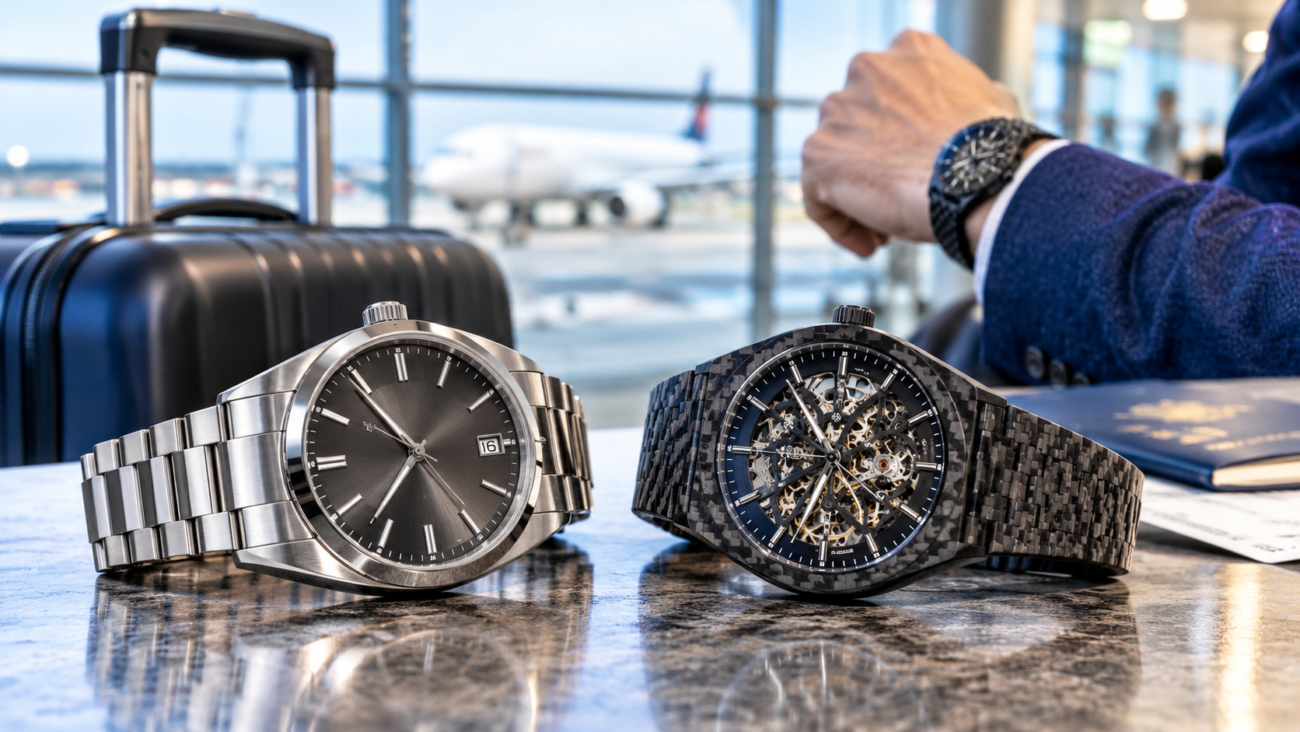
Spend six hours in a window seat between New York and London, and every ounce of gear you wear starts to announce itself. Stiff leather dress shoes pinch as cabin pressure changes, heavy belt buckles dig in during turbulence, and a traditional 185-gram stainless-steel bracelet watch begins to feel like a steel shackle sliding up and down your wrist bone.
Experienced business travelers have spent years streamlining their carry-on packing lists with wrinkle-resistant merino wool, polycarbonate luggage, and compact GaN chargers. Now that same obsession with weight-to-durability ratios has reshaped what frequent flyers wear on their wrists. Instead of rigid metal links and scratch-prone polished bezels, modern travelers are increasingly reaching for curved, barrel-shaped composite watches engineered from layered carbon fiber and technical ceramics.
The Hidden Travel Flaws of Traditional Luxury Steel
Classic steel chronographs and dive watches earned their reputation decades ago for legibility and water resistance, yet everyday air travel punishes traditional watch cases in three predictable ways:
- Mid-Flight Wrist Expansion: At cruising altitude, mild fluid retention causes most travelers’ wrists to expand by a quarter to half a centimeter. Unless a metal bracelet includes a tool-free micro-adjustment clasp, the watch goes from comfortable in the departure lounge to painfully tight halfway across the Atlantic.
- Overhead-Bin Bezel Scratches: Hoisting a carry-on roller into a tight overhead compartment or sliding a laptop out of an aluminum-zippered sleeve inevitably scrapes a tall steel bezel. Mirror-polished 316L or 904L steel shows hairline scuffs after a single three-city itinerary.
- Top-Heavy Case Balance: Most mechanical travel watches concentrate 100 grams or more in the watch head alone. When walking briskly between concourses, that off-center mass creates constant wrist fatigue.
How Tonneau Geometry and Laminated Carbon Solve Long-Haul Fatigue
Modern architectural sports watches tackle wrist fatigue from the inside out. Watchmaking educators at organizations like the Horological Society of New York frequently highlight how material science has transformed mechanical watchmaking over the past twenty years—moving beyond brass and steel into aerospace-grade titanium, silicon escapements, and autoclave-cured composites.
Rather than stamping a flat circular puck of metal, contemporary tonneau (barrel-shaped) sports watches curve both the front sapphire crystal and the rear caseback to match the natural arc of the human ulna. When that curved silhouette is CNC-machined from micro-layered carbon sheets compressed at 45-degree angles, the entire watch—strap included—can drop down to between 32 and 48 grams. Paired with a vented fluororubber or seamless elastic textile strap, the case stays centered without leaving red pressure marks after a twelve-hour flight.
| Travel Wear Factor | Traditional Steel Bracelet Watch | Laminated Carbon / Ceramic Tonneau |
| Typical Total Weight | 155g – 195g (top-heavy on wrist) | 32g – 52g (near-weightless balance) |
| Altitude Wrist Swell | Rigid links pinch without micro-adjust | Vented rubber or elastic weave flexes naturally |
| Carry-On Scratch Resistance | Polished steel shows scuffs immediately | TZP ceramic & matte carbon hide wear |
| Wardrobe Versatility | Formal steel clashes with athletic travel gear | Openworked grey bridges match suits or hoodies |
What Discerning Buyers Check When Comparing Accessible Carbon Builds
Because limited-run Swiss composite watches routinely trade in the six-figure bracket—making them a magnet for unwanted attention in unfamiliar cities—many frequent travelers prefer wearing high-precision super-clone or tribute builds on the road. That way, they enjoy the curved ergonomics, openworked mechanical dial, and scratch-resistant composite shell without carrying the anxiety of insuring a house-priced heirloom through hotel safes and taxi rides.
However, not every tonneau watch sold online uses genuine composite materials. Collectors who review movement architecture and case tolerances on RichardMilleReplica.io point out a massive divide between $270 tourist-grade novelties and true 1:1 super-clone engineering. Before packing a skeleton sports watch for your next trip, verify three concrete mechanical details:
1. Genuine Layered NTPT Carbon vs. Hydro-Dipped Alloy
Budget lookalike sites often cast heavy zinc alloy cases and coat them with a printed carbon-pattern film that peels at the lugs. Real laminated carbon displays organic, non-repeating wave striations that subtly catch cabin lighting at different angles while keeping the case genuinely featherlight.
2. True Skeletonized Calibers vs. Thick Spacer Rings
An authentic ultra-thin travel reference like the RM 67-02 profile measures roughly 7.8 millimeters thick, sliding effortlessly under a dress shirt cuff. Low-grade copies stuff generic automatic movements into 15-millimeter housings with decorative plastic grids. Purpose-built skeleton calibers—such as integrated RMUL2 automatic architectures—anchor titanium-toned bridges directly into the case perimeter for clean visual depth and reliable 50-hour power reserves.
3. Gasket Care Across Changing Climates
Multi-part tonneau housings rely on precision nitrile O-rings compressed by spline screws. While splash-resistant for sudden rainstorms or handwashing in an airport lounge, skeletonized mechanical watches should stay out of hotel steam rooms and heated whirlpools, where rapid thermal expansion can compromise seal longevity.
Pack Smarter, Wear Lighter
The best travel gear earns its spot by disappearing until the moment you need it. Swapping a bulky steel bracelet for a contoured carbon or white ceramic skeleton watch trims unnecessary weight, shrugs off cabin bag scrapes, and transitions seamlessly from a morning client coffee to a late-night red-eye home.
