

Ariana Grande vocal range is one of the most talked-about voices in modern pop music, and for good reason. The range most commonly cited for her is about four octaves, roughly from D3 to E7, and she is widely described as a light lyric soprano with a whistle register at the very top. That combination of a strong low end, powerful belts in the middle, and whistle notes above the normal soprano range is what makes her voice stand out, even in a field full of talented singers. This guide explains what those numbers actually mean, where the claims come from, which songs show each part of her range, and how her voice compares with other famous singers.
What Is Ariana Grande’s Vocal Range?
The short answer is that Ariana Grande’s vocal range is most often described as four octaves, approximately D3 to E7. The D3 is a low note below middle C, and the E7 is an extremely high whistle note, more than two octaves above the top note most sopranos sing in opera. Put together, that span covers about fifty semitones, or four octaves and a whole step.
It is important to be honest about where that figure comes from. The D3 to E7 range is the one repeated across vocal-profile sites and reference pages, and it is also the figure given on her Wikipedia biography, which describes her as a soprano with a four-octave range extending into the whistle register. There is no single official measurement of a singer’s full range, because a range depends on which performances you count and whether you include whistle notes and vocal fry. So D3 to E7 is best understood as the widely accepted summary of her voice, not a laboratory result. Within that span, her comfortable singing range is often given as roughly F-sharp3 to G-sharp5, which is where most of her melodies actually sit.
For context, most professional pop singers work comfortably across about two octaves. A four-octave span is unusual, and it is why her voice became her calling card.
Ariana Grande’s Lowest Notes: The Bottom Of Her Range
People usually talk about Ariana Grande because of her high notes, but her low range is more impressive than many listeners realise. The lowest note most often credited to her is D3, a note below middle C that sits in alto territory. For a soprano, that is a genuinely useful low end, because it lets her sing warm, rounded phrases in the lower part of a song.
One example often pointed to by vocal analysts is her version of “Take Care”, where she is heard singing around E3. Another is “Just a Little Bit of Your Heart”, where some listeners have suggested she reaches as low as C-sharp3, although that claim is disputed. What is not disputed is that her lower register is relatively strong for a soprano. Analysts who have studied her recordings describe her low notes as supported down to around F-sharp3, with a smoky quality that suits slower, more emotional songs.
This matters because a wide range is only useful if the whole of it sounds good. That is why songs like “pov” work so well: they live in the middle and lower parts of her voice, and the warmth there gives the song its intimate feeling.
Her Belting Range: Where The Power Lives
Between the low notes and the whistle register sits the part of Ariana Grande’s voice that does most of the work: her belt. A belt is a powerful, chest-voice sound carried up into the higher notes, and Grande can belt up to around B5. Her belts are often described as bright and reliable up to around E6 in live performance, which is a remarkable place for a pop singer to be comfortable.
You can hear that power clearly on “Dangerous Woman”, where the chorus builds on strong, sustained high notes, and on “Into You”, a song whose published sheet music lists a vocal line from F-sharp3 to F-sharp5. That two-octave span inside a single song is a good, checked example of how much ground she covers in ordinary pop material, without any whistle notes at all. Her voice has a light quality, which means it does not sound heavy or forced at the top, and that lightness is part of why she can move quickly between a soft verse and a full belt in the same song.
The Whistle Register: Her Signature High Notes
The whistle register is the highest register of the human voice, sitting above the falsetto. Notes in this register sound clear and piercing, almost like a flute or a whistle, because the vocal cords close almost completely and only a tiny opening lets air through. Very few pop singers can use it musically, and it is the part of Ariana Grande’s vocal range that fans talk about most.
Her whistle register is generally said to start around G6, and her highest note is most often given as E7. She reaches that note in her cover of Mariah Carey’s “Emotions”, a song famous for its own whistle-note ending, and the cover is the clearest example of her whistle ability. She has also used whistle notes as flourishes at the ends of songs such as “The Way”, where the little bird-like sounds in the closing moments are whistle tones rather than ordinary high notes.
It is worth noting that even Grande herself has said she does not have full control in the very top of this register, particularly around the seventh octave. Whistle notes are an effect and a colour in her voice, not the foundation of it. Most of her songs are built on the middle of her range, and the whistle notes are the decoration on top.
What Voice Type Is Ariana Grande?
Ariana Grande is generally classified as a light lyric soprano. In classical singing, a lyric soprano is a voice with a warm, bright quality and enough power to be heard over an orchestra, while “light” means the voice is not heavy or dramatic in weight. Some analysts add the word “coloratura”, which describes a singer who is especially agile with fast runs, trills, and ornaments. Grande’s quick vocal runs, the little flourishes she adds to the ends of phrases, are a good example of that agility.
It is worth saying that these classical labels are descriptions, not boxes. A pop singer’s voice does not have to fit neatly into an operatic category. The practical facts matter more: her voice sits high, it is bright and agile, it has real power in the middle, and it extends into the whistle register at the top. Her longtime vocal coach, Eric Vetro, has worked with her for years, and reports have also noted that she did not have formal classical training, which makes the control she shows over such a wide range all the more notable.
How Her Range Compares To Other Famous Singers
Comparisons help put four octaves in perspective. Mariah Carey, the singer Grande is most often compared with, is usually credited with a range of five octaves or more, from around F2 to G-sharp7, including her own legendary whistle notes. Carey is the benchmark for the whistle register in pop, and Grande’s cover of “Emotions” is a direct nod to that influence.
Other well-known voices give useful context too. Whitney Houston and Celine Dion are generally credited with ranges of around three octaves, while Beyoncé is usually placed at around three to four octaves. The point is not that one number makes a singer better than another. Range is only one part of singing, and tone, phrasing, emotion, and songwriting matter at least as much. But a four-octave span does place Grande in a small group of mainstream pop singers.
The Songs That Show Off Her Range Best
If you want to hear Ariana Grande’s vocal range for yourself, a few songs make the best listening guide.
“The Way”, her debut single with Mac Miller from the 2013 album Yours Truly, is where many listeners first noticed her. The song moves between soft, low phrases and bright high notes, and it ends with whistle-note flourishes that immediately drew comparisons with Mariah Carey. Yours Truly itself debuted at number one on the Billboard 200, and its retro R&B sound was built around her voice rather than around production tricks.
“Dangerous Woman”, the title track of her 2016 album, shows the belting side of her range. The chorus sits high and demands power, and the song’s slow, bluesy feel gives her room to stretch out phrases and add runs. “Into You”, from the same album, is a cleaner example of her middle range, with a published vocal line of F-sharp3 to F-sharp5.
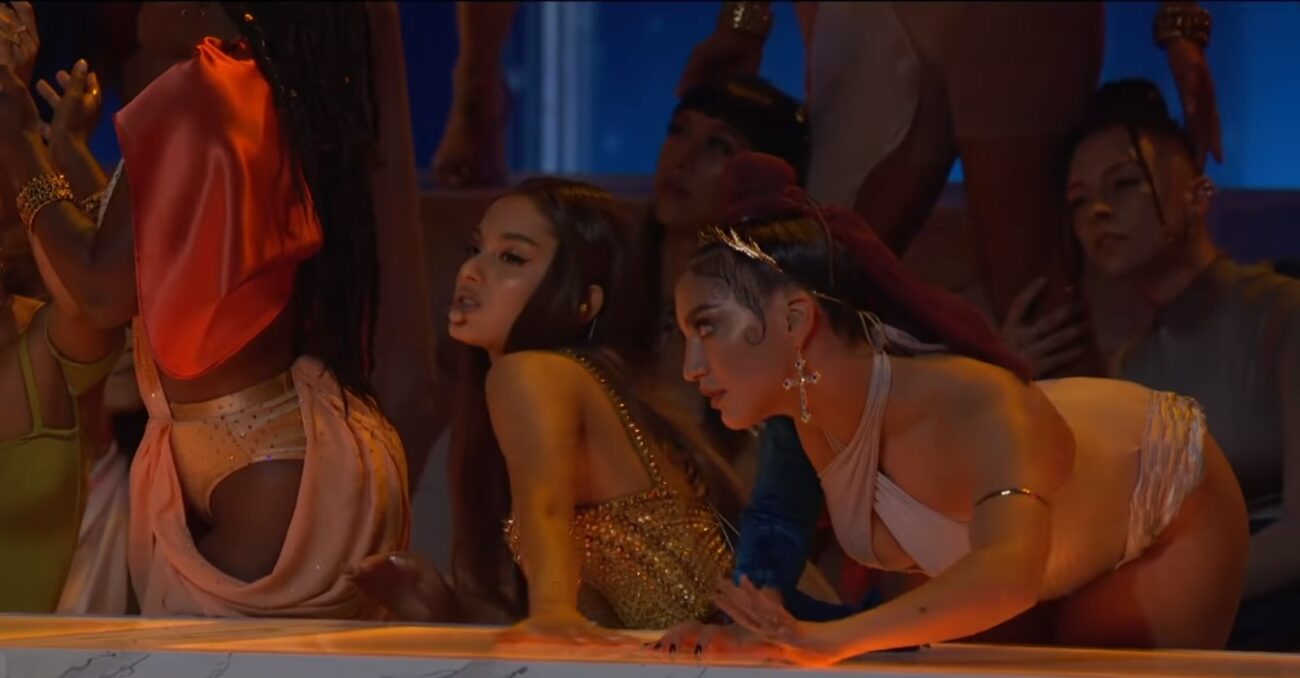
“God Is a Woman”, from Sweetener in 2018, is the song she performed at the 2018 MTV Video Music Awards, and it shows her voice at its most controlled and layered. Sweetener went on to win her first Grammy Award, for Best Pop Vocal Album, in 2019.
More recently, her role as Glinda in the film Wicked (2024) asked her to sing in a different style again. “Defying Gravity”, her duet with Cynthia Erivo, won the Grammy for Best Pop Duo/Group Performance in 2026, and it is a good example of how her voice works in a musical-theatre setting, where clarity and projection matter as much as range. She earned an Academy Award nomination for Best Supporting Actress for playing Glinda, and she returned to the role in the sequel, Wicked: For Good, in 2025.
How She Built A Voice Like That
Ariana Grande was born on June 26, 1993, in Boca Raton, Florida. She began her career as a teenager on Broadway, appearing in the musical 13 in 2008, and then rose to fame playing Cat Valentine on the Nickelodeon series Victorious from 2010 to 2013 and its spin-off Sam & Cat. Singing on television every week gave her years of practical experience before her first album.
Her debut album, Yours Truly, arrived in 2013, followed by My Everything in 2014, Dangerous Woman in 2016, Sweetener in 2018, thank u, next in 2019, Positions in 2020, and eternal sunshine in 2024. Across that run, her voice has stayed remarkably consistent, even as the style of her music changed. That consistency is a sign of good technique and good care, not just natural talent.
She has won three Grammy Awards from twenty nominations, according to the Recording Academy: Best Pop Vocal Album for Sweetener in 2019, Best Pop Duo/Group Performance for “Rain on Me” with Lady Gaga in 2021, and the same award for “Defying Gravity” with Cynthia Erivo in 2026.
Can You Learn To Sing Like Ariana Grande?
Many readers search for Ariana Grande’s vocal range because they want to sing her songs themselves, so here is some practical, honest advice. First, do not start with the whistle notes. Learn the core melody of a song in a comfortable key, and only add the high flourishes once the verse and chorus feel easy. A song like “pov” is a better starting point than “Emotions”, because it lives in the connected middle of the voice and teaches phrasing and breath control.
Second, choose the right key. Her songs are written for a high soprano, and most singers will need to lower the key by a few semitones. That is normal and sensible. Third, work on runs slowly. Grande’s fast vocal runs sound effortless, but they are built on clear pitch centres and good breath support. Practise a run slowly, one note at a time, and only speed it up when every note is in tune.
Finally, look after your voice. Warm up before singing, stay hydrated, and rest if your voice feels tired or hoarse. No amount of range is worth damaging the voice you have. If you are serious about extending your range, a qualified vocal coach can help far more than any online video.
Frequently Asked Questions About Ariana Grande Vocal Range
How Many Octaves Can Ariana Grande Sing?
Ariana Grande is most commonly credited with a vocal range of about four octaves, roughly from D3 to E7. That figure is repeated across vocal profiles and reference pages, although exact endpoints vary by source, so it should be read as the widely accepted summary of her voice rather than a single certified measurement.
What Is Ariana Grande’s Highest Note?
Her highest note is most often given as E7, a whistle-register note she reaches in her cover of Mariah Carey’s “Emotions”. Some sources suggest she may have touched higher notes in passing, but E7 is the highest note most consistently documented.
What Is Ariana Grande’s Lowest Note?
Her lowest note is most often given as D3. Some listeners have suggested she may have sung as low as C-sharp3 on “Just a Little Bit of Your Heart”, but that claim is disputed, so D3 is the safer figure to use.
Is Ariana Grande A Soprano?
Yes. She is generally classified as a light lyric soprano, with some analysts adding “coloratura” to describe her agility with fast runs and ornaments. Her voice sits high, sounds bright and light, and extends into the whistle register above the normal soprano range.
Does Ariana Grande Sing In The Whistle Register?
Yes. The whistle register is a real part of her voice, starting around G6. You can hear it in her cover of “Emotions” and in the closing flourishes of “The Way”. She has also said she does not have full control at the very top of this register, which is normal even for very skilled singers.
Who Has A Bigger Vocal Range, Ariana Grande Or Mariah Carey?
Mariah Carey is generally credited with a wider range, at five octaves or more, compared with Ariana Grande’s commonly cited four octaves. Carey is the singer Grande is most often compared with, and her cover of Carey’s “Emotions” is a direct tribute to that influence.
Conclusion: Why Ariana Grande Vocal Range Still Fascinates Fans
Ariana Grande vocal range fascinates people because it is both rare and musical. A four-octave span from D3 to E7 is impressive on paper, but what keeps listeners coming back is how she uses it. The low notes give her songs warmth, the belts give them power, and the whistle notes give them a sparkle that few other pop singers can match. Across seven studio albums, from Yours Truly to eternal sunshine, and through her turn as Glinda in Wicked, she has shown that range is not just about hitting extreme notes. It is about having the right sound for every moment of a song.
