
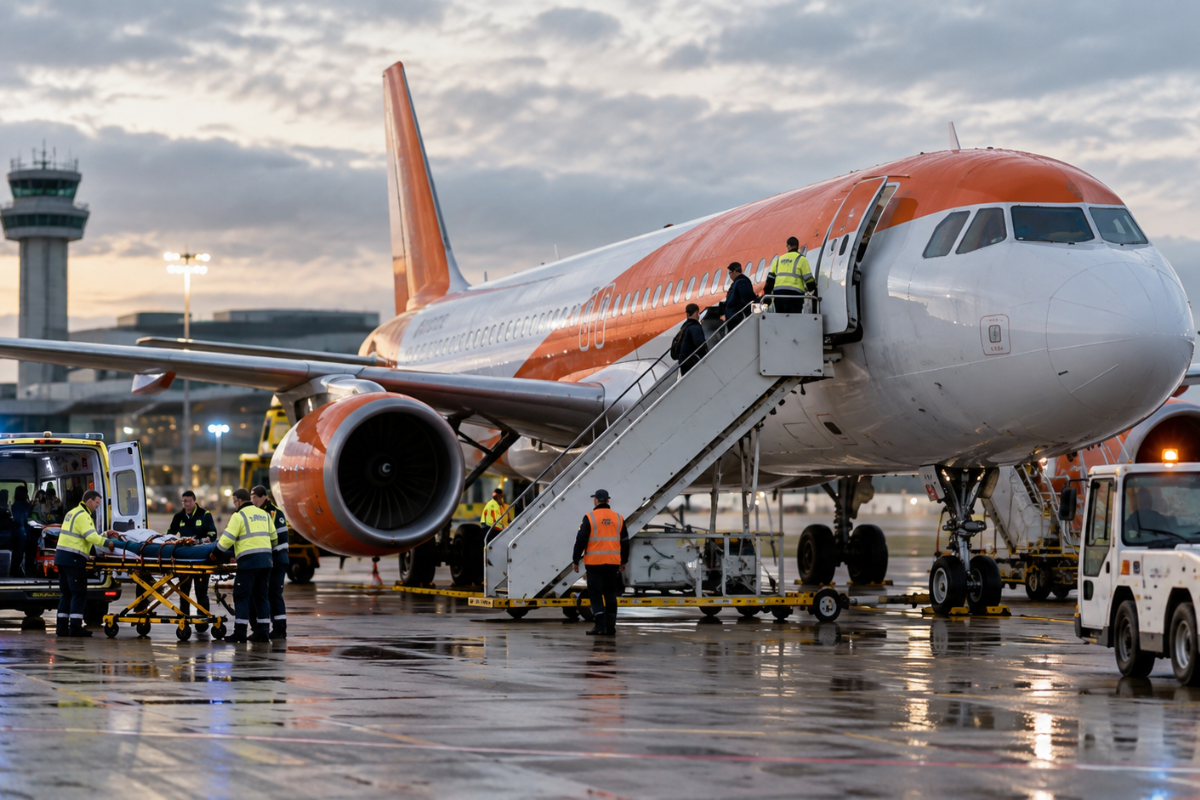
An easyJet flight from Copenhagen to Manchester diverted to Newcastle International Airport on October 27, 2025 after a passenger experienced a medical or welfare emergency onboard. The aircraft landed safely in Newcastle and later continued to Manchester. Contemporary reporting and flight data identify the affected service as U2 2238, commonly rendered in some databases as U22238 and tracked under the ICAO designator EZY2238.
That distinction matters because U2238 is a different easyJet flight number associated with the Newcastle-Bristol route. Flight-history services currently list U2238 as Newcastle to Bristol, while U2 2238/EZY2238 is the Copenhagen-Manchester service.
So, if you searched for “easyJet flight U2238 emergency landing Newcastle,” you are most likely looking for the October 27 incident involving U2 2238/U22238/EZY2238.
What Happened to EasyJet Flight U2238 in Newcastle?
The incident involved an easyJet Airbus A320 operating from Copenhagen Airport to Manchester Airport. During the flight, a passenger required urgent medical attention. The crew responded to the situation and diverted the aircraft to Newcastle International Airport rather than continuing to Manchester.
The aircraft landed safely at Newcastle. Medical personnel then attended to the situation on the ground. After the diversion and medical response, the aircraft resumed its journey and eventually reached Manchester.
There is an important distinction between the phrase “emergency landing” and what actually happened. The aircraft did make an emergency diversion and landed at an airport other than its planned destination, but the available reporting does not indicate that the aircraft was crashing or suffering a confirmed catastrophic mechanical failure. The reported reason for the diversion was a passenger welfare or medical issue.
Was the Flight U2238 or U22238?
This is where much of the online confusion comes from.
Why The Flight Numbers Look Confusing?
easyJet uses U2 as its IATA airline designator. The service involved in the incident had the flight number 2238, so it can be written as U2 2238. When systems concatenate the airline designator and flight number, it can appear as U22238.
The airline’s three-letter ICAO designator is EZY, so the same service can appear in aviation tracking systems as EZY2238. Flight schedule data lists the Copenhagen-Manchester service as EZY2238 / U22238.
That is different from U2238, which represents the shorter flight number U2 238. Current flight-history data identifies U2238 as an easyJet service between Newcastle and Bristol.
U2238 vs U22238 vs EZY2238
| Identifier | What it represents | Connection to the October 27 incident |
| U2 2238 | easyJet’s two-letter airline designator plus flight number 2238 | The affected Copenhagen-Manchester service |
| U22238 | A concatenated form used by some databases | The affected service |
| EZY2238 | easyJet’s ICAO designator plus flight number 2238 | The affected service |
| U2238 | U2 + flight number 238 | A different Newcastle-Bristol service |
| EZY238 | ICAO-style identifier for U2 238 | Different flight |
The safest way to describe the incident is therefore easyJet U2 2238 / U22238 / EZY2238, rather than treating U2238 as the technically correct flight number.
Why Did the easyJet Flight Divert to Newcastle?
The reported reason was a passenger welfare or medical emergency.
According to contemporary reporting, the passenger required urgent medical attention while the aircraft was flying from Copenhagen toward Manchester. The crew declared an emergency and diverted to Newcastle so the passenger could receive assistance on the ground.
A diversion is a normal safety option available to flight crews when continuing to the original destination is not the best course of action. In a medical situation, an airport with suitable emergency services can provide a faster or more appropriate response than continuing the flight.
The public reports do not establish the passenger’s specific diagnosis, and there is no need to speculate about it. The useful fact for readers is that the diversion was reported as being connected to passenger welfare rather than a confirmed major aircraft malfunction.
What Does Squawk 7700 Mean?
Squawk 7700 is the standard transponder code used to indicate an emergency.
Aircraft use transponders to send identification and other information to air traffic control. The UK Civil Aviation Authority identifies 7700 as the emergency code, alongside 7500 for unlawful interference and 7600 for radio communication failure.
When an aircraft uses 7700, it tells air traffic services that the flight is experiencing an emergency and may require priority handling.
However, 7700 does not tell the public exactly what caused the emergency. An emergency code can be associated with different situations, including medical problems, technical issues or other urgent circumstances.
For this flight, available reporting connected the emergency with the passenger welfare situation.
Timeline of the Newcastle Diversion
The publicly available information can be summarized as follows:
- The flight departed Copenhagen.
The aircraft was operating a scheduled service to Manchester. - A passenger welfare issue developed.
Reports said a passenger required urgent medical attention. - The crew responded to the situation.
The aircraft’s emergency status was communicated while the flight was over the North Sea. - The aircraft diverted toward Newcastle.
Newcastle International Airport became the diversion destination. - The aircraft landed safely.
The aircraft landed at Newcastle and taxied to the airport facilities. - Medical personnel attended.
Paramedics took over the medical response after the aircraft reached the airport. - The aircraft remained at Newcastle temporarily.
The diversion allowed the immediate passenger welfare situation to be dealt with on the ground. - The flight prepared to continue.
After the diversion, the aircraft resumed its journey. - The aircraft continued to Manchester.
The service eventually completed the remaining journey to its original destination.
Exact timing can vary slightly between flight-tracking systems and published reports, so the sequence is more useful than presenting unverified minute-by-minute claims.
What Happened After the Plane Landed?
Once the aircraft reached Newcastle, medical personnel attended the passenger who had required assistance.
The available public reports do not provide enough reliable information to describe the passenger’s medical diagnosis or subsequent condition. Those details should therefore not be presented as fact.
What can be established is that the aircraft itself did not remain permanently diverted. After the situation at Newcastle was handled, the flight continued toward Manchester. One contemporary aviation report records the aircraft resuming the journey and arriving in Manchester shortly afterward.
This is also why describing the incident simply as an “emergency landing” can give the wrong impression. The aircraft’s diversion was serious enough to require emergency handling, but the available evidence does not show that the aircraft was lost, crashed or rendered incapable of continuing its journey.
Was There an Aircraft Mechanical Problem?
There is no reliable evidence establishing an engine failure, fire or other major aircraft malfunction as the cause of this particular diversion.
The contemporary reports available for the incident attribute the diversion to a passenger welfare or medical emergency.
That distinction is important. An aircraft can declare an emergency because of a problem involving a passenger, even when the aircraft itself is operating normally.
Therefore, readers should not interpret the use of the emergency code or the Newcastle diversion as proof that the aircraft suffered an engine or structural failure.
Did the Flight Eventually Reach Manchester?
Yes. The aircraft later continued from Newcastle to Manchester after the emergency diversion.
An aviation incident report records the aircraft resuming the journey after approximately an hour on the ground and subsequently arriving at Manchester.
The fact that the aircraft continued is consistent with the reported nature of the incident: the diversion was associated with a passenger medical situation rather than a publicly confirmed catastrophic aircraft failure.
Did the Newcastle Diversion Affect Other Flights?
The diversion also had a temporary effect on other traffic using the area around Newcastle.
Flight-tracking records show Air France flight AFR1558, operating from Paris Charles de Gaulle to Newcastle, was involved in the surrounding traffic sequence that evening. The archived tracking data records the flight arriving into the Newcastle area during the same period.
Contemporary reporting also said the Air France service was held while the easyJet aircraft was dealt with at Newcastle.
This illustrates why an emergency diversion can affect more than the aircraft experiencing the problem: air traffic controllers may need to adjust the movement of other aircraft to give the emergency flight priority and maintain safe separation.
What Is Confirmed — and What Is Still Unknown?
A useful way to understand the incident is to separate established information from details that remain unclear publicly.
Confirmed Or Strongly Supported By Available Reporting
- The incident occurred on October 27, 2025.
- The affected service was travelling from Copenhagen to Manchester.
- The aircraft diverted to Newcastle International Airport.
- A passenger welfare or medical emergency was reported.
- The crew declared an emergency.
- The aircraft landed safely at Newcastle.
- Medical personnel attended after landing.
- The aircraft later continued toward Manchester.
Details That Should Not Be Presented As Established Fact
- The passenger’s identity.
- A specific medical diagnosis.
- The passenger’s later medical condition.
- Claims about the passenger’s private medical treatment unless officially released.
- Dramatic descriptions of panic or fear among passengers.
- A specific mechanical fault that has not been confirmed by a reliable source.
This distinction matters because aviation incident stories can quickly become distorted when later articles repeat details from earlier reports without checking their original basis.
What Does This Mean for Passengers?
An emergency diversion does not automatically mean that passengers are entitled to a particular amount of compensation.
Passenger rights depend on the circumstances, the applicable law and the reason for the disruption. GOV.UK explains that UK air-passenger rules can provide rights to care, assistance, refunds or alternative travel in qualifying circumstances, while compensation for delays may depend on whether the delay resulted from circumstances within the airline’s control.
For a specific claim, passengers should therefore check the airline’s records for the disruption and the rules applicable to their journey rather than assuming that every emergency diversion produces the same compensation outcome.
The broader lesson is simpler: safety takes priority over the original schedule. When a passenger needs urgent medical attention, diverting to an appropriate airport can be the safest option even when that creates delays for everyone onboard.
Conclusion
The easyJet emergency diversion to Newcastle on October 27, 2025 was a real incident involving the Copenhagen-Manchester service U2 2238, also represented in aviation data as U22238/EZY2238. A passenger required urgent medical attention, prompting the crew to declare an emergency and divert to Newcastle. The aircraft landed safely, medical personnel attended, and the flight later continued to Manchester.
The most important correction for readers searching for “easyJet flight U2238 emergency landing Newcastle” is the flight number itself: U2238 is a separate Newcastle-Bristol service. The October 2025 incident involved the longer 2238 flight number, represented as U2 2238/U22238 and EZY2238.
Understanding that distinction makes the incident much easier to follow—and avoids confusing two different easyJet services.
FAQs
Did easyJet flight U2238 make an emergency landing in Newcastle?
The incident commonly described online as the “easyJet U2238 emergency landing” involved the U2 2238 / U22238 / EZY2238 Copenhagen-Manchester service. It diverted and landed safely at Newcastle because of a passenger welfare or medical emergency. U2238 itself is a different easyJet flight number associated with Newcastle-Bristol.
Why did the easyJet flight divert to Newcastle?
The aircraft diverted because a passenger reportedly required urgent medical attention. The crew declared an emergency and diverted to Newcastle so medical assistance could be provided on the ground.
Was the flight actually U22238?
The affected service is commonly represented as U2 2238 and appears as U22238 in some databases. Its ICAO identifier is EZY2238. It should not be confused with U2238, the separate Newcastle-Bristol service.
What is EZY2238?
EZY2238 is the ICAO-style identifier associated with easyJet’s Copenhagen-Manchester service numbered 2238. Flight schedule data lists the service as EZY2238 / U22238.
Was there an engine failure?
There is no reliable public evidence establishing an engine failure as the cause of the Newcastle diversion. Available reports attributed the emergency to a passenger welfare or medical issue.
Did the aircraft land safely?
Yes. The aircraft landed safely at Newcastle International Airport, where medical personnel attended the passenger.
Did the plane continue to Manchester?
Yes. After the Newcastle diversion, the aircraft resumed its journey and later arrived at Manchester.
What does Squawk 7700 mean?
Squawk 7700 is the standard transponder code indicating an aircraft emergency. The UK Civil Aviation Authority lists 7700 as the emergency code. The code itself does not identify the specific cause of the emergency.
What happened to the passenger?
Public reports establish that a passenger required urgent medical assistance, but they do not provide sufficient reliable information to state the passenger’s diagnosis or later medical condition. It is therefore better not to speculate.
Are passengers entitled to compensation?
Not automatically. Passenger compensation depends on the applicable passenger-rights rules and the cause and circumstances of the disruption. GOV.UK explains that compensation for qualifying flight delays can depend on whether extraordinary circumstances caused the disruption.
