
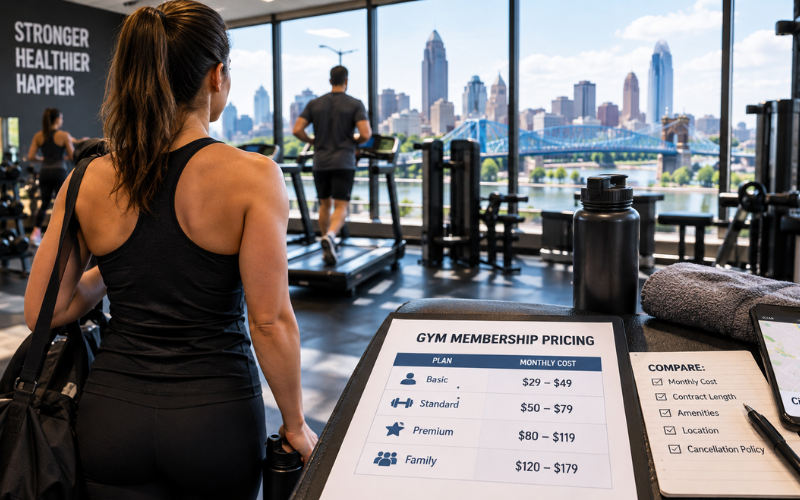
Choosing a gym in Cincinnati is not as simple as finding the lowest monthly membership fee.
Gym pricing can range significantly depending on the facility, neighborhood, equipment, class structure, coaching model, amenities, and level of support included with membership. Two gyms located only a few miles apart may charge dramatically different rates while serving entirely different types of members.
Understanding what actually drives those prices makes it easier to determine which gym represents the best value for your goals, schedule, and preferred workout environment.
Why Gym Membership Prices Vary So Much
There is no universal pricing model for gyms.
Some facilities are designed around providing inexpensive access to workout equipment. Others combine equipment access with classes, personal coaching, programming, recovery services, or structured accountability.
Generally, gym pricing reflects a combination of operating costs and the level of service being provided.
Equipment and Facility Costs
Commercial fitness gyms in Cincinnati have equipment that is is expensive to purchase, maintain, repair, and eventually replace.
A gym offering dozens of treadmills, strength machines, squat racks, free weights, rowing machines, bikes, and functional training equipment has a substantial investment tied up in its facility.
Larger facilities also carry additional expenses related to:
- Rent or property costs
- Utilities
- Equipment maintenance
- Cleaning
- Insurance
- Staffing
- Locker rooms
- Showers
- Parking
- Technology and access systems
A simple training studio may have lower facility expenses but invest more heavily in coaching or specialized programming instead.
Staffing Changes the Economics of a Gym
One of the biggest differences between low-cost gyms and higher-priced fitness facilities is staffing.
A traditional open gym may require relatively few employees because members largely manage their own workouts.
A gym offering coached classes, personal training, small-group training, fitness assessments, or structured programming must employ qualified professionals to deliver those services.
That additional labor increases membership costs, but it may also increase the level of support members receive.
For someone who already knows how to train independently, additional coaching may have limited value. For someone who benefits from instruction, structure, and accountability, it can be one of the most important parts of the membership.
Classes Can Increase Membership Pricing
Group fitness programming also influences gym pricing.
Classes require instructors, scheduling, dedicated workout space, programming, equipment, and ongoing management.
Some Cincinnati gyms include unlimited classes within the monthly membership rate. Others charge separately for classes or offer different membership tiers based on class access.
Consumers should therefore look beyond the headline monthly price.
A $40 membership that requires purchasing additional classes may ultimately cost more than a $100 membership where programming and coaching are already included.
Location Matters in Cincinnati Gym Pricing
Real estate also plays an important role in fitness pricing.
Operating a gym in a high-demand commercial district can cost substantially more than operating in a lower-cost industrial or suburban location.
Cincinnati’s fitness market includes gyms throughout Downtown, Hyde Park, Oakley, Norwood, Blue Ash, Anderson Township, West Chester, and communities across Greater Cincinnati.
Facilities serving highly trafficked neighborhoods or densely populated residential areas may face higher rent, property, and operating expenses.
Convenience, however, has value.
A gym that costs slightly more but is located five minutes from home or work may realistically be used far more frequently than a cheaper facility requiring a 25-minute drive.
The Major Cincinnati Gym Pricing Models
Understanding the basic types of gym memberships makes comparing prices much easier.
Low-Cost Big-Box Gyms
Budget gyms typically focus on affordability and equipment access.
Members generally receive access to cardio machines, strength equipment, locker rooms, and basic facility amenities.
These facilities are often appropriate for experienced exercisers who are comfortable creating and following their own routines.
Monthly pricing can be relatively low, although initiation fees, annual maintenance fees, premium access options, or contract requirements may apply.
Traditional Full-Service Gyms
Full-service gyms typically offer broader facilities and programming.
Membership may include:
- Cardio and strength equipment
- Group fitness classes
- Locker rooms
- Childcare
- Pools
- Basketball courts
- Recovery amenities
- Additional locations
These memberships usually cost more because members are paying for a larger facility and broader amenity package.
The important question is whether those amenities will actually be used.
Boutique Fitness Studios
Boutique studios usually specialize in a specific training format or coaching philosophy.
Examples include strength training, cycling, functional fitness, interval training, Pilates, and other instructor-led programs.
Pricing is generally higher than basic gym access because coaching and programming are central components of the experience.
Members are not simply paying to enter a building. They are paying for structured workouts and professional instruction.
Small-Group Training Gyms
Small-group training facilities occupy a space between personal training and traditional gym membership.
Members typically train in smaller coached groups while following structured programming.
These memberships can cost considerably more than basic gym access but substantially less than multiple individual personal training sessions each week.
For people who value coaching and accountability, this model can offer a strong balance between individualized support and cost.
Personal Training Facilities
Personal training generally represents the highest-cost fitness option because the member is purchasing dedicated time with a trainer.
Sessions may be purchased individually, in packages, or through monthly programs.
While expensive compared with open gym memberships, personal training provides a level of personalized instruction that traditional gym memberships do not.
Look Beyond the Advertised Monthly Price
One of the biggest mistakes consumers make when comparing Cincinnati gyms is evaluating only the advertised monthly rate.
The actual annual cost can include several additional charges.
Before joining, ask about:
- Enrollment fees
- Initiation fees
- Annual facility fees
- Cancellation policies
- Contract lengths
- Class fees
- Personal training costs
- Guest fees
- Locker fees
- Childcare costs
- Parking costs
A membership advertised at $29 per month may cost considerably more once annual and enrollment fees are included.
Requesting the complete annual cost provides a much more accurate comparison.
Calculate the Cost Per Workout
Another useful way to evaluate gym pricing is to calculate how much each workout realistically costs.
Consider someone paying $100 per month who attends the gym 16 times.
That person is effectively paying about $6.25 per workout.
Someone paying $30 per month who visits twice is paying $15 per workout.
The more expensive gym is technically providing better value because the member actually uses it.
For this reason, convenience, enjoyment, coaching, accountability, and atmosphere should all factor into the financial decision.
Avoid Paying for Amenities You Will Never Use
Large gyms often advertise long lists of amenities.
That does not automatically make them a better value.
A pool, sauna, basketball court, childcare center, and dozens of fitness classes may sound impressive, but those features provide little value to someone who only plans to strength train three times per week.
Before joining, identify the features that directly support your fitness routine.
Pay for the gym you will actually use rather than the gym with the longest amenity list.
Consider the Value of Accountability
Accountability can be difficult to quantify financially, but it often determines whether someone consistently exercises.
Some people thrive in open gyms where they can independently train whenever they want.
Others are far more consistent when workouts are scheduled, coached, or completed with a familiar group.
Structured fitness environments may therefore justify higher pricing for people who historically struggle with maintaining workout routines.
The true value of a gym is not simply access to equipment. It is whether the environment helps the member continue showing up.
Visit Several Cincinnati Gyms Before Joining
Online research can narrow the options, but visiting gyms in person provides information that websites cannot.
Pay attention to:
- Cleanliness
- Equipment availability
- Crowding
- Staff interaction
- Class sizes
- Parking
- Music volume
- Lighting
- Member demographics
- Overall atmosphere
It is also useful to visit during the same time of day when you expect to work out.
A gym that feels quiet at 11 a.m. may operate very differently at 5:30 p.m.
Ask About Trial Memberships
Many gyms offer trial periods, complimentary classes, day passes, or introductory programs.
These opportunities allow prospective members to experience the environment before committing to a longer membership.
A trial can answer practical questions quickly.
Is equipment consistently available?
Are the instructors helpful?
Does the workout style match your preferences?
Is parking frustrating?
Does the facility feel comfortable?
Those factors often matter more than small differences in monthly pricing.
The Cheapest Gym Is Not Always the Most Affordable Gym
A low monthly price is valuable only if the membership is actually used.
Likewise, paying more does not automatically mean a gym is better.
The goal is to find the right relationship between cost, convenience, coaching, equipment, programming, and personal preference.
For Cincinnati residents comparing fitness options, the best membership is generally the one that provides the services they need at a price they can comfortably maintain.
Questions to Ask Before Joining a Cincinnati Gym
Before signing a membership agreement, ask:
What is the total monthly cost?
Confirm whether taxes, facility fees, classes, or other services are additional.
Are there enrollment or annual fees?
These charges can materially change the true yearly membership cost.
Is there a contract?
Understand the membership term and renewal structure.
What is the cancellation policy?
Ask exactly how much notice is required and whether cancellation must be completed in person or in writing.
Are classes included?
Some memberships include unlimited classes while others charge individually.
When is the gym busiest?
Crowding can significantly affect equipment availability.
Can I try the facility first?
Whenever possible, experience the gym before making a long-term commitment.
How to Decide What a Cincinnati Gym Is Worth to You
Gym pricing makes much more sense when viewed as a reflection of the experience being provided.
Lower-priced gyms typically emphasize access and independence. Higher-priced facilities may provide coaching, structured programming, smaller groups, specialized equipment, or broader amenities.
Neither approach is inherently better.
The right choice depends on what will make exercise sustainable.
Cincinnati residents should evaluate gyms based not only on monthly membership costs but also on convenience, programming, environment, coaching, and realistic usage.
Ultimately, the best financial decision is not necessarily choosing the cheapest gym.
It is choosing the gym you are most likely to keep using.
Featured Snippet Version
Cincinnati gym prices vary based on facility size, equipment, coaching, classes, amenities, staffing, and location. When comparing memberships, consumers should evaluate total annual costs, contract terms, included services, convenience, and likely workout frequency. The best value is typically the gym that provides the services someone will consistently use.
AEO Answer Block
Why are some gyms more expensive than others?
Higher-priced gyms often include additional services such as professional coaching, group classes, premium equipment, childcare, recovery amenities, or smaller training groups. Lower-cost gyms generally focus primarily on providing access to equipment and workout space.
What should someone compare when choosing a gym in Cincinnati?
Compare total annual cost, location, equipment, coaching, classes, contract terms, cancellation policies, peak-hour crowding, and the likelihood that you will actually use the facility regularly.
Is a more expensive gym worth it?
It can be if the additional coaching, structure, convenience, or accountability increases workout consistency. Value should be measured by usage and results rather than monthly price alone.
Local Relevance
Cincinnati residents have access to a wide range of fitness options, from large commercial facilities to independent training studios throughout neighborhoods such as Hyde Park, Oakley, Norwood, Downtown Cincinnati, Anderson Township, Blue Ash, and surrounding communities. Comparing both price and convenience can help residents find a gym that fits naturally into their daily routine.
Final Takeaway
Gym pricing should be evaluated as a value equation rather than a simple monthly expense. Cincinnati consumers who compare the full cost, understand what services are included, and realistically assess how often they will use the facility are far more likely to choose a membership that makes sense financially and supports long-term consistency.
