
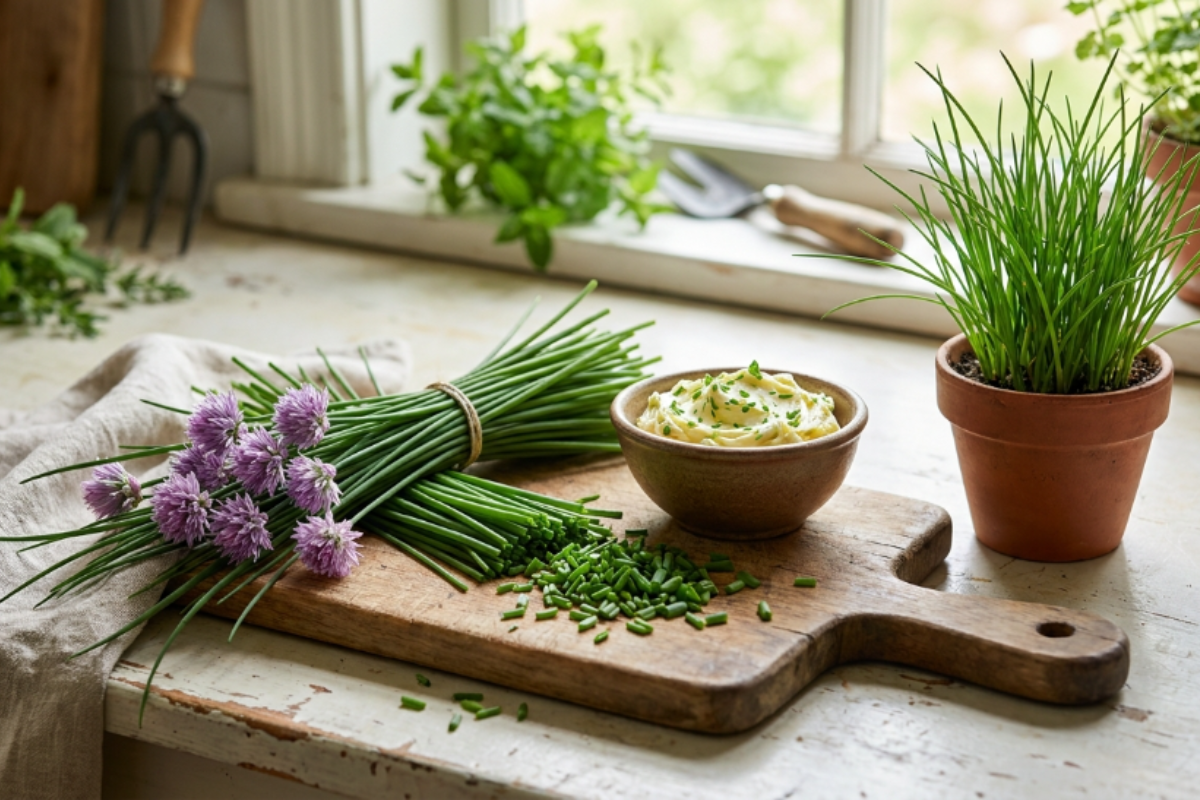
Chives are a small, versatile herb best known for their delicate green leaves and mild onion-like flavor. They belong to the Allium group, the same broad plant family that includes onions, garlic, and leeks. Common chives are scientifically known as Allium schoenoprasum.
Unlike full-sized onions, chives grow in compact clumps with thin, hollow leaves. They are often chopped and added to foods such as potatoes, eggs, salads, soups, sauces, and creamy dishes. Their flowers are also edible and can add both color and a mild onion flavor to meals.
This guide explains what chives are, what they taste like, how they are used, their nutritional value, how they compare with similar ingredients, and how to grow, harvest, store, and prepare them.
What Chives Are and Where They Come From?
Chives are a perennial herb that grows from small underground bulbs and forms dense clumps of narrow leaves. Their scientific name is Allium schoenoprasum, and they belong to the Amaryllidaceae family.
They are closely related to onions, garlic, and leeks, but their growth and appearance make them easy to distinguish. Instead of producing a large onion bulb for cooking, chives are mainly grown for their slender green leaves and edible flowers.
Chives are also relatively easy to grow and can remain productive for years when properly maintained. They can be grown in garden beds or containers and can tolerate both full sun and partial shade.
What Chives Look Like?
Fresh chives are easy to recognize. Their leaves are narrow, green, cylindrical, and hollow inside. They grow upward from the base of the plant in dense clumps and can reach roughly 30 centimeters in height.
When chives flower, they produce rounded flower heads held above the leaves. Common chive flowers are usually purple or pink, although white-flowered forms also exist. Both the leaves and flowers are edible.
When buying fresh chives, look for leaves that are bright green, firm, and fresh-looking. Avoid bunches with large amounts of yellowing, wilted, or damaged foliage.
What Chives Taste Like?
Chives have a mild onion-like flavor with a fresh, slightly sharp quality. Their taste is generally much more delicate than that of a raw onion, making them useful when you want onion flavor without allowing it to dominate a dish.
Their aroma becomes noticeable when the leaves are cut or crushed. Because their flavor is delicate, chives are commonly chopped finely and added to foods shortly before serving or used raw as a finishing herb. The Royal Horticultural Society specifically recommends chives for their fresh onion flavor and notes that they are best used raw.
Common Culinary Uses for Chives
Chives are one of the easiest herbs to add to everyday meals. Their mild flavor works particularly well with foods that have creamy, buttery, savory, or mild flavors.
Chopped fresh chives can be sprinkled over baked or mashed potatoes, scrambled eggs, omelets, soups, salads, pasta, and cream cheese. They can also be mixed into butter to create simple chive butter or added to dips and sauces.
Chives are especially useful as a finishing herb. Rather than treating them like a strong cooking ingredient, you can add a small amount at the end to give a dish a fresh onion note.
They can be eaten raw or cooked, although prolonged cooking can reduce some of their delicate flavor. Using them fresh also makes their bright green color more noticeable.
Chive Flowers and Their Uses
Chive flowers are edible and can be used in much the same way as the leaves. They grow in rounded clusters and are particularly attractive when added to salads and other finished dishes.
The flowers have a mild onion flavor and can be separated into individual small flowers before being scattered over food. They can add color, texture, and a subtle chive taste without overpowering the main ingredients.
Chives generally produce their rounded flower heads in late spring and summer, although the exact timing depends on growing conditions.
Chives Nutrition and Nutritional Value
Chives are a low-calorie herb that can contribute small amounts of several nutrients to the diet. USDA nutrient data for raw chives lists about 30 calories per 100 grams, along with protein, carbohydrates, dietary fiber, and other nutrients.
They also provide vitamins and minerals, including vitamin K and vitamin C. Chives contain plant compounds such as flavonoids, including quercetin and kaempferol.
However, serving size is important. People usually use chives as a garnish or flavoring rather than eating large portions of them. Therefore, the amount of nutrients obtained from a typical serving will be considerably smaller than the values listed per 100 grams.
Potential Health Benefits of Chives
The nutritional value of chives makes them a useful addition to a varied diet. Their vitamin and plant-compound content can contribute to overall dietary quality, particularly when herbs such as chives are used to add flavor to nutritious meals.
Vitamin K is an important nutrient involved in normal blood clotting and bone metabolism, while vitamin C contributes to normal immune function and helps the body absorb iron from plant foods.
Chives also contain naturally occurring antioxidant compounds. However, it is important not to treat chives as a medicine or claim that eating them can prevent or cure specific diseases. Their realistic value comes from being a flavorful, nutrient-containing herb that can form part of a balanced diet.
Chives vs. Green Onions, Scallions, and Other Similar Herbs
Chives, green onions, and scallions are related but are not the same ingredient. Chives have very thin, hollow leaves and form clumps from small bulbs, while green onions generally have thicker leaves and a more noticeable white base.
Chives also have a more delicate flavor. Green onions and scallions tend to provide a stronger onion taste and can be used in larger amounts as an ingredient.
Spring onions can have a more developed bulb and stronger onion character, while shallots form bulbs and have a different flavor and texture altogether.
The best choice depends on the dish. Chives work particularly well when you want a light onion flavor, while green onions or scallions may be better when a dish needs a stronger onion presence.
Chives vs. Garlic Chives
Garlic chives are a related plant but are different from common chives. Common chives are Allium schoenoprasum, while garlic chives are Allium tuberosum. Both belong to the same broader plant group.
One of the easiest differences to notice is the leaf shape. Common chives have narrow, cylindrical, hollow leaves, while garlic chives have flatter leaves. Garlic chives also have a noticeable garlic-like flavor.
Both plants have edible leaves and flowers, but they offer different flavors. Common chives are better when you want a mild onion taste, while garlic chives can provide a combination of onion and garlic notes.
How to Grow Chives at Home?
Chives are considered an easy herb to grow and can work well for both gardens and containers. They grow in full sun or partial shade and prefer soil that retains some moisture while still draining well.
You can start chives from seeds or purchase established plants. Starting with an established plant is generally a quick way to get a usable clump, while seeds offer another simple option.
Chives can also be grown in containers, making them suitable for balconies, patios, and small gardens. For indoor growing, place them somewhere bright, such as a sunny windowsill.
Regular harvesting encourages fresh growth. Established clumps can also be divided to create additional plants. The RHS recommends dividing large clumps every few years to prevent overcrowding and maintain strong growth.
How to Harvest Chives?
Chives can be harvested once they have produced enough healthy leaves to cut. The simplest method is to use clean scissors and snip the leaves close to the base.
Regular harvesting encourages the plant to produce new leaves. The RHS recommends cutting leaves just above the base and removing faded foliage at the same time.
Chive flowers can also be harvested once they open. If you want the plant to produce seeds naturally, however, you can leave some flowers on the plant instead.
After flowering, cutting the plant back can encourage a new flush of foliage.
How to Store and Preserve Fresh Chives?
Fresh chives are best used soon after harvesting or purchasing because their delicate leaves can wilt over time. Keep them refrigerated and protected from excessive moisture until you are ready to use them.
For longer storage, chives can be frozen. Freezing can preserve their usefulness as a cooking herb, although the texture will not be the same as freshly cut chives.
Drying is another preservation option, but dried chives generally have a less fresh flavor and texture than the newly harvested herb. If a recipe depends on the bright, delicate character of fresh chives, fresh leaves are usually the better choice.
How to Prepare Chives for Cooking?
Before using fresh chives, rinse them gently under cool water and remove any damaged leaves. Pat them dry, then cut them into small pieces with a sharp knife or kitchen scissors.
Fine chopping works particularly well because it distributes the mild onion flavor throughout a dish. Chives can be added to salads, potatoes, eggs, soups, creamy dishes, and sauces.
For the freshest flavor, add them toward the end of cooking or sprinkle them over the finished dish. Their delicate flavor is easier to notice when they are not exposed to prolonged heat.
Conclusion: Making the Most of Chives
Chives are a simple but versatile herb with thin green leaves, a mild onion flavor, and edible flowers. They can bring freshness to potatoes, eggs, salads, soups, sauces, and many other dishes without overpowering the main ingredients.
They also provide useful nutrients and plant compounds while being easy to grow at home. Whether you buy fresh chives from a store, grow them in a container, or harvest them from your garden, they are a practical herb to keep available.
The key to making the most of chives is simple: use their delicate flavor to add a fresh onion note, prepare them gently, and add them near the end of cooking whenever you want their characteristic taste to stand out.
FAQs
What are chives?
Chives are a perennial herb known for their thin, hollow green leaves and mild onion-like flavor. Their scientific name is Allium schoenoprasum.
What do chives taste like?
Chives have a mild, fresh onion flavor that is generally more delicate than raw onions or green onions.
Are chives and green onions the same?
No. They are related plants, but chives are much thinner and have a milder flavor, while green onions generally have thicker leaves and a stronger onion taste.
Can you eat chives raw?
Yes. Fresh chives can be eaten raw and are commonly chopped and used as a garnish or finishing herb.
Are chive flowers edible?
Yes. Chive flowers are edible and have a mild onion flavor. They can be separated into small flowers and added to salads and other dishes.
Are chives healthy?
Chives provide nutrients such as vitamin K and vitamin C and contain plant compounds with antioxidant activity. They are best viewed as part of a balanced diet rather than as a treatment for health conditions.
Can you freeze fresh chives?
Yes. Fresh chives can be frozen for longer storage. The texture may change after freezing, so frozen chives are generally more suitable for cooked dishes than for uses where fresh texture is important.
How long do fresh chives last?
Fresh chives are best used while they are still crisp and green. Refrigeration can help slow wilting, but storage life varies depending on freshness and storage conditions.
Do chives come back every year?
Yes. Common chives are perennial plants and can return year after year when grown in suitable conditions.
What are garlic chives?
Garlic chives are a related Allium plant with flatter leaves and a garlic-like flavor. They are different from common chives, which have cylindrical, hollow leaves.
