
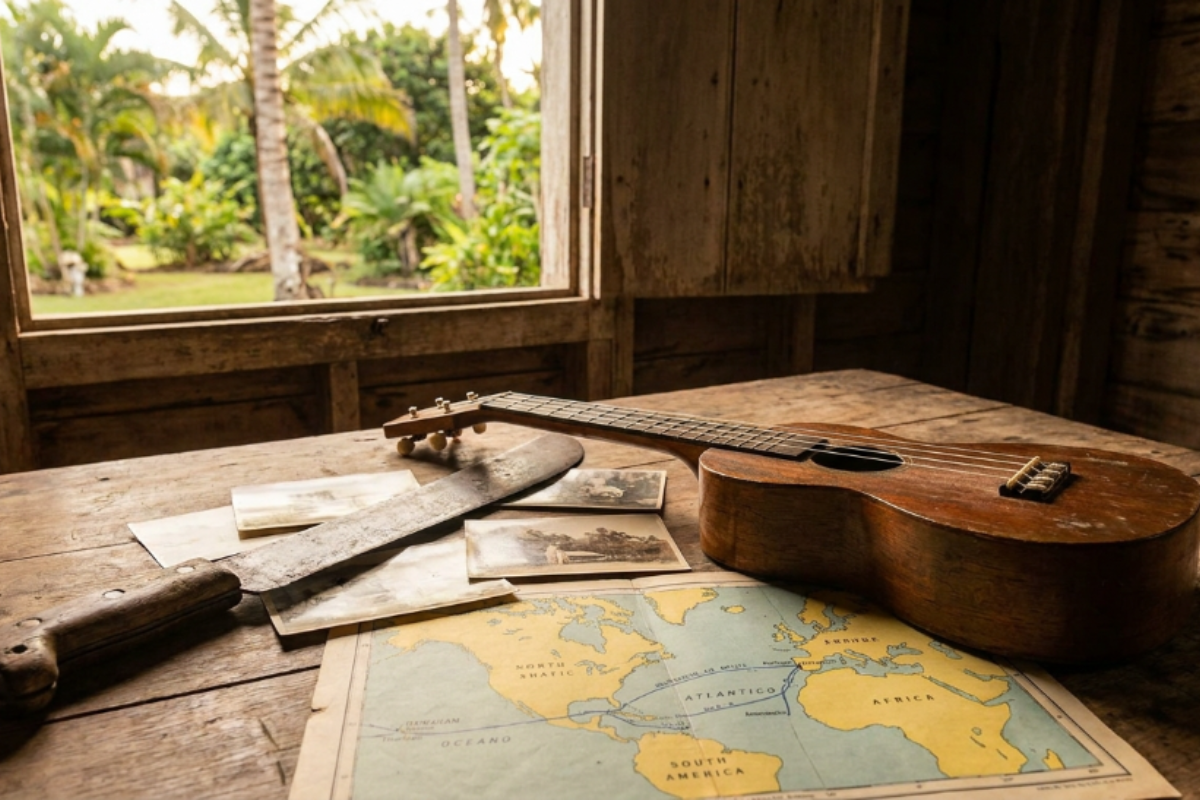
The history of the ukulele is a story of migration, cultural exchange, craftsmanship, and music. Although the ukulele is strongly associated with Hawaii today, its story began with Portuguese musical traditions and instruments from Madeira. Portuguese settlers brought small stringed instruments to Hawaii in the late 19th century, where local makers and musicians adapted them into something new.
The ukulele is a small, four-stringed instrument that became an important part of Hawaiian music and culture. Its history explains how a European folk instrument was transformed in Hawaii and eventually became known around the world.
The modern ukulele emerged after Portuguese instruments arrived in Hawaii in 1879. Among the important early makers were Manuel Nunes, Augusto Dias, and José do Espírito Santo. They helped develop instruments that were suited to Hawaiian musical tastes.
In this guide to ukulele history, we will follow that journey from Madeira and Portugal to Hawaii, explore the people who helped shape the instrument, and look at how the ukulele eventually spread beyond the islands.
The Portuguese Roots Behind the Ukulele
The origins of the ukulele can be traced to Portuguese musical traditions, particularly those of Madeira, an island belonging to Portugal. Madeira had a strong tradition of small stringed instruments that were played for entertainment and social gatherings.
Several Portuguese instruments are connected with the development of the ukulele. These include the braguinha, machete, rajão, and cavaquinho. They were not simply early versions of the modern ukulele, but they provided important musical and design influences.
The braguinha was a small Portuguese guitar associated with Madeira. The machete was another Madeiran stringed instrument, while the rajão was typically a larger instrument. The cavaquinho was a small Portuguese instrument that also became part of the wider family of instruments connected with the ukulele’s development.
The Metropolitan Museum of Art notes that Portuguese settlers brought the braguinha to Hawaii and that the instrument was later modified to suit local musical tastes. Its collection also identifies the Madeiran rajão as an instrument that inspired the creation of the ukulele.
This distinction is important when discussing ukulele history. The modern Hawaiian ukulele was not simply copied from one Portuguese instrument. Instead, it developed through adaptation and change after these musical traditions reached Hawaii.
The Ukulele Arrives in Hawaii in 1879
A major turning point in ukulele history came in 1879, when Portuguese immigrants arrived in Hawaii. Many Portuguese workers came to the islands as part of the growing labor force, particularly for the sugar industry. Some brought their musical traditions and instruments with them.
The arrival of the SS Ravenscrag is especially important. Portuguese workers traveling aboard the ship reached Hawaii in 1879, and among them were skilled woodworkers who knew how to make small Portuguese instruments.
The Metropolitan Museum of Art identifies Manuel Nunes, Augusto Dias, and José do Espírito Santo among the Portuguese settlers who knew how to make the braguinha. These craftsmen later played an important role in the development of the Hawaiian ukulele.
The University of Hawaii also records the arrival of Portuguese workers in August 1879 and explains that Hawaiians quickly adopted and modified the Portuguese braguinha.
Once the instrument reached Hawaii, it did not remain exactly as it had been in Madeira. Hawaiian musicians and makers began adapting it, and this process eventually produced the instrument now recognized as the ukulele.
The First Hawaiian Ukulele Makers
Three names are especially important when studying the early history of the ukulele: Manuel Nunes, Augusto Dias, and José do Espírito Santo.
These Portuguese craftsmen had experience working with small stringed instruments. After arriving in Hawaii, they became involved in making instruments for the local community.
Manuel Nunes is particularly associated with the early development of the instrument. Augusto Dias and José do Espírito Santo also established workshops and produced instruments during the early years of the Hawaiian ukulele.
The Smithsonian notes that the first ukulele makers in Hawaii came from Madeira and that Nunes, Dias, and José do Espírito Santo went on to establish workshops in Honolulu.
By the late 19th century, these makers were producing instruments for a growing Hawaiian market. Their work helped turn an imported Portuguese musical tradition into a distinctly Hawaiian instrument.
Rather than pointing to one person as the sole inventor, it is more accurate to understand the early ukulele as the result of several makers, musicians, and cultural influences working together.
How the Ukulele Developed in Hawaii?
The instrument that arrived from Portugal was adapted after it became part of Hawaiian musical life. Hawaiian musicians developed their own ways of playing it, while local makers changed aspects of its construction and sound.
This process helped create an instrument that was different from its Portuguese relatives. The Hawaiian ukulele became smaller, distinctive in sound, and closely connected with the musical traditions developing in the islands.
Wood also became an important part of its identity. Hawaiian koa became strongly associated with ukulele construction and remains an important traditional material. Early examples, however, were not all made from koa. The Metropolitan Museum’s approximately 1880 ukulele, for example, is made from mahogany, hardwood, and metal.
The development of the Hawaiian ukulele shows that its history was not simply about bringing an existing instrument from one country to another. It was about adaptation. Hawaiian musicians and craftsmen took an imported musical form and made it part of their own cultural environment.
King Kalākaua and the Rise of the Ukulele
King David Kalākaua, who ruled the Hawaiian Kingdom from 1874 to 1891, played an important role in the cultural history of the ukulele. He was a strong supporter of Hawaiian music, dance, and cultural traditions and was also interested in musical innovation.
The ukulele found favor at the Hawaiian royal court. Under Kalākaua’s patronage, the instrument became connected with performances and Hawaiian cultural events.
The Metropolitan Museum explains that the ukulele was welcomed at Kalākaua’s court and that his patronage helped the instrument become part of performances accompanying hula.
This association helped strengthen the ukulele’s place in Hawaiian culture. Over time, it became far more than an imported Portuguese instrument. It became an important symbol of Hawaiian music and identity.
The Meaning and Origin of the Name “Ukulele”
The origin of the word ukulele is one of the more interesting parts of ukulele history, but it is also an area where different explanations exist.
The Hawaiian word is commonly translated as “jumping flea.” One traditional explanation connects the name with the quick movements of a player’s fingers across the strings. Another story connects the name with Edward Purvis, a small and energetic figure associated with King Kalākaua’s court.
The Metropolitan Museum presents both of these explanations while also noting another possibility involving the Hawaiian ʻukeke, a traditional mouth bow.
Because several explanations have been recorded, it is better not to present one popular story as an unquestionable fact. The history of the name reflects the same cultural mixture that shaped the instrument itself.
The Ukulele Spreads Beyond Hawaii
As the ukulele became established in Hawaii, its reputation gradually spread beyond the islands. Hawaiian music and performers helped introduce mainland audiences to the instrument.
A major milestone came in 1915, when the Panama-Pacific International Exposition was held in San Francisco. Hawaii had a pavilion at the exposition, and Hawaiian musicians performed there.
The Smithsonian identifies the 1915 exposition as a particularly important moment in the ukulele’s wider rise to international prominence. Hawaiian performers at the event helped introduce the sound and image of Hawaiian music to a large mainland audience.
This exposure helped create a new audience for the ukulele in the United States. The instrument’s small size, approachable sound, and association with Hawaiian music made it attractive to many listeners and performers.
The Ukulele’s Popularity in the United States
During the early 20th century, the ukulele became increasingly visible in American popular culture. Hawaiian music had a major influence on the way mainland audiences viewed the islands, and the ukulele became one of its most recognizable symbols.
The instrument appeared in entertainment and popular music and developed a strong presence outside Hawaii. Its history during this period included both serious musical use and lighter forms of entertainment.
The popularity of the ukulele did not remain constant. Like many musical instruments, it experienced periods of intense interest and periods when public attention declined.
The University of Hawaii describes the instrument as having once been extremely popular, later being taken for granted, and eventually experiencing a renewed interest.
Its long history therefore includes both major periods of popularity and quieter periods. Even when its popularity changed, however, the ukulele remained an important part of Hawaiian musical culture.
How the Ukulele Changed Over Time?
The ukulele has changed considerably since its early development in Hawaii. Makers have experimented with different shapes, sizes, woods, construction methods, and approaches to sound.
Different ukulele sizes eventually became common, giving players more choices in sound and playing range. Modern ukuleles can also be made from a wide variety of woods and manufactured using techniques that were unavailable to early Hawaiian makers.
Tuning and playing styles have also developed over time. While traditional Hawaiian playing remains important, musicians around the world have incorporated the ukulele into many different musical settings.
The difference between an early Hawaiian ukulele and a modern instrument can therefore be significant. Yet the basic identity of the instrument remains recognizable: a compact stringed instrument with a distinctive voice and strong historical connection to Hawaii.
Ukulele History Timeline: Major Milestones
The major stages of ukulele history can be understood as a gradual journey rather than a single moment of invention.
Portuguese musical traditions from Madeira provided important foundations. Small Portuguese stringed instruments such as the braguinha and related instruments were brought into contact with Hawaiian musicians.
In 1879, Portuguese immigrants arrived in Hawaii, bringing their musical traditions with them. Soon afterward, craftsmen including Manuel Nunes, Augusto Dias, and José do Espírito Santo helped establish local instrument making.
By the late 19th century, the adapted instrument had become part of Hawaiian musical life. Its association with King Kalākaua and the royal court further strengthened its cultural importance.
In 1915, the Panama-Pacific International Exposition helped introduce Hawaiian music and the ukulele to a much larger American audience.
During the 20th century, the ukulele moved through different periods of popularity before experiencing renewed interest. Its story eventually became global, with musicians in many countries adopting the instrument.
How Hawaiian Culture Shaped Ukulele History?
The ukulele’s Portuguese roots are essential to its history, but its identity cannot be separated from Hawaii.
Hawaiian musicians adopted the instrument and made it part of local musical life. It became connected with Hawaiian songs, performances, hula, royal culture, and the broader cultural image of the islands.
This transformation is one of the most important lessons in ukulele history. The instrument began with Portuguese influences, but Hawaii gave it a new cultural identity.
The University of Hawaii describes the ukulele as an important part of Hawaiian music and notes its continuing relationship with the cultural life of the islands.
That history also explains why the ukulele is still so strongly associated with Hawaii today, even though its earliest ancestors came from Portuguese musical traditions.
The Ukulele in Modern History
The ukulele continued to change after its early popularity. New manufacturing methods made instruments more widely available, while recordings, radio, television, and later the internet helped musicians introduce the instrument to new audiences.
The University of Hawaii Press describes the ukulele’s history as a journey that includes periods of international popularity, decline, and renewed interest. It also highlights the role of changing technologies in spreading the instrument.
Today, the ukulele is played far beyond Hawaii. It appears in many musical settings and is made in numerous styles and sizes. At the same time, its historical connection with Hawaiian music remains an important part of its identity.
The modern popularity of the ukulele is therefore the latest stage in a much longer story that began with Portuguese instruments and continued through Hawaiian adaptation and global musical exchange.
Conclusion
The history of the ukulele is much richer than the simple image of a small Hawaiian instrument. Its story begins with Portuguese musical traditions, especially those of Madeira, and continues with the arrival of Portuguese immigrants in Hawaii in 1879.
Craftsmen such as Manuel Nunes, Augusto Dias, and José do Espírito Santo helped transform Portuguese influences into a new Hawaiian instrument. Hawaiian musicians adopted it, developed its sound and role in local music, and connected it with the culture of the islands.
From the Hawaiian royal court to the 1915 Panama-Pacific International Exposition and eventually audiences around the world, the ukulele continued to evolve and gain new meaning.
Understanding this history shows why the ukulele is more than a simple four-stringed instrument. It represents a remarkable meeting of Portuguese and Hawaiian traditions and a musical journey that continues to this day.
FAQs
Where did the ukulele originally come from?
The ukulele developed in Hawaii from Portuguese musical traditions and small stringed instruments brought to the islands by Portuguese immigrants. Its immediate roots are particularly connected with Madeira.
Was the ukulele invented in Hawaii?
The modern Hawaiian ukulele was developed in Hawaii, but it did not originate there in the sense of having no earlier influences. Portuguese instruments such as the braguinha provided important foundations for its development.
Who invented the ukulele?
There is no simple answer naming one undisputed inventor. Manuel Nunes, Augusto Dias, and José do Espírito Santo were among the most important early makers associated with the development of the Hawaiian ukulele.
When did the ukulele come to Hawaii?
Portuguese immigrants brought the instrument’s Portuguese ancestors to Hawaii in 1879. This is generally regarded as the key starting point for the ukulele’s development in Hawaii.
What Portuguese instrument influenced the ukulele?
Several Portuguese instruments are connected with its development, especially the braguinha, along with the machete, rajão, and cavaquinho.
Who were the first Hawaiian ukulele makers?
Manuel Nunes, Augusto Dias, and José do Espírito Santo are among the best-known early Hawaiian ukulele makers. They came from Madeira and helped establish local ukulele making in Honolulu.
What does the word ukulele mean?
The word is commonly translated as “jumping flea,” but several explanations for the name have been recorded. Historical sources do not present a single explanation as unquestionably proven.
Why is the ukulele associated with Hawaii?
Hawaiian musicians adopted and modified the instrument after its arrival from Portuguese communities. It became an important part of Hawaiian music and culture and later became a major symbol associated with the islands.
When did the ukulele become popular in America?
The instrument gained wider American attention in the early 20th century. The 1915 Panama-Pacific International Exposition in San Francisco was a major milestone in its growing international prominence.
How has the ukulele changed over time?
The ukulele has evolved in its construction, materials, sizes, manufacturing methods, and playing styles. Modern instruments can differ significantly from early Hawaiian examples, while still retaining the basic character of the original instrument.
