
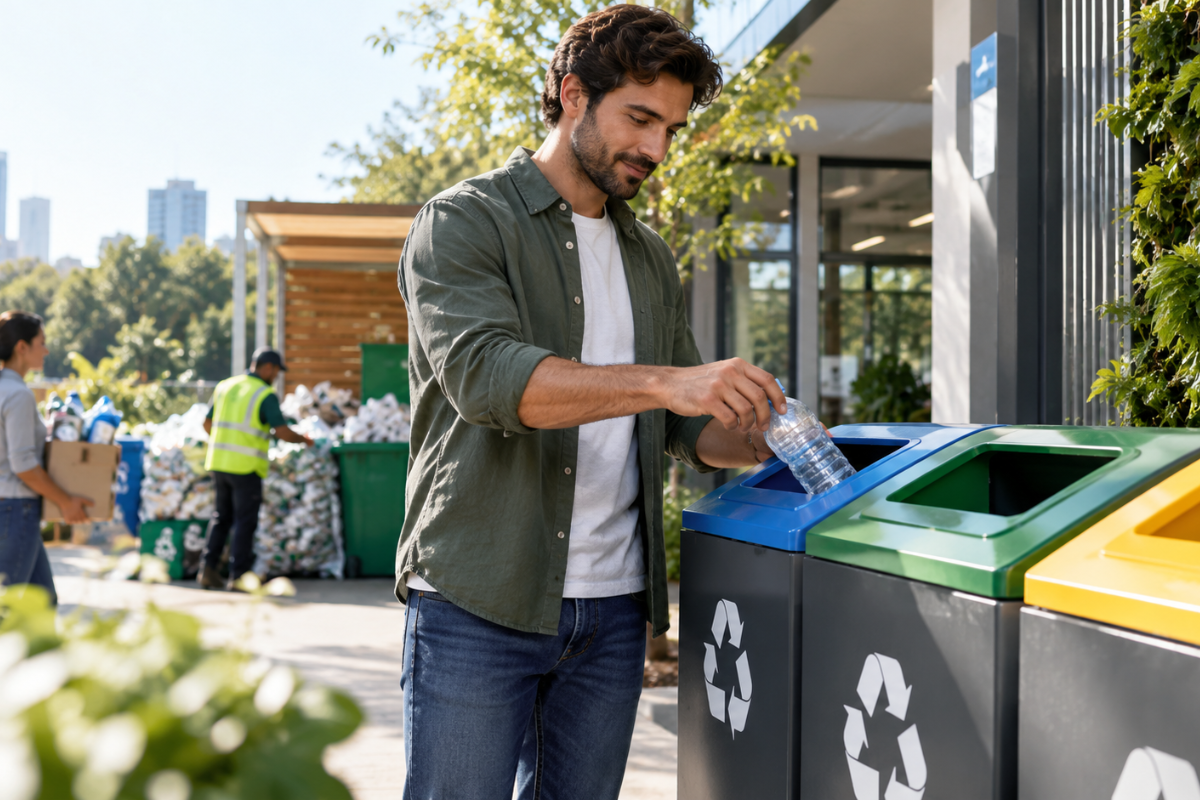
MataRecycler is an online name associated with recycling, sustainability, and discussions about smarter waste management. The confusing part is that websites do not describe it consistently. MataRecycler.org presents itself as an information platform and digital magazine covering modern recycling, sustainability, and technology.
Elsewhere online, MataRecycler is described as an AI-powered recycling system involving cameras, sensors, smart bins, automated sorting, and data tools. However, those descriptions should not automatically be treated as specifications for a verified commercial product.
The key is therefore to separate what is documented about MataRecycler itself from what is genuinely possible with modern smart-recycling technology.
What Is MataRecycler?
MataRecycler is best understood as an online name associated with recycling and sustainability information. While some third-party websites describe it as an AI-powered smart-recycling platform, publicly available evidence does not clearly establish one commercial MataRecycler machine or technology platform with all the features commonly attributed to it.
MataRecycler at a Glance
| Detail | Answer |
| Name | MataRecycler |
| Main association | Recycling, sustainability, and recycling technology |
| Online presence | Informational websites and articles |
| AI system | Frequently described online, but not clearly established as one documented commercial product |
| Physical machine | No clearly documented commercial machine established in the sources reviewed |
| Mobile app | No clearly established official recycling app found in the reviewed evidence |
| Main reader issue | Different websites provide conflicting descriptions |
This distinction is important. A technology can sound technically realistic without there being enough evidence to conclude that a specific named product actually provides it.
Why MataRecycler Is Difficult to Define?
Search for MataRecycler and you can encounter very different explanations. One page may treat it as a smart recycling platform, another may discuss AI sorting, and another may present MataRecycler simply as an information source.
The underlying smart-recycling concepts are real. What is uncertain is whether all of them belong to a single MataRecycler product.
MataRecycler as an Information Platform
The clearest first-party description comes from MataRecycler.org itself.
Its About page describes Mata Recycler as a platform providing updated information about modern and sustainable recycling. It also describes the site as a digital magazine providing recycling and technology information.
The website itself publishes content beyond recycling, including technology, business, health, and lifestyle-related subjects.
That provides evidence for MataRecycler as an online publishing identity.
It does not, by itself, establish the existence of a commercial recycling machine.
MataRecycler as a Supposed Smart-Recycling System
A different picture appears on third-party websites.
Some describe MataRecycler as a system combining technologies such as:
- artificial intelligence (AI);
- cameras and computer vision;
- smart sensors;
- automated sorting;
- Internet of Things (IoT) connectivity;
- smart recycling bins;
- mobile applications;
- cloud-based analytics.
One recent article, for example, describes these capabilities while also acknowledging that clear official product documents, ownership information, pricing, and confirmed deployments have not been established.
This creates an important evidence problem: these technologies certainly can be used for recycling, but that does not prove that a particular MataRecycler product uses all of them.
Why the Distinction Matters?
There are three very different things that could carry the same name:
A content brand publishes information about recycling.
A concept describes an approach to smarter recycling without necessarily being a commercial product.
A commercial technology has an identifiable developer or manufacturer, specifications, documentation, customers, and usually some way to obtain or deploy it.
Confusing those categories can turn a plausible description into an unsupported factual claim.
Is MataRecycler a Real Company, Product, or Recycling Machine?
MataRecycler clearly has a real online presence. What is much harder to establish is whether it represents a specific commercial AI recycling system matching the detailed descriptions circulating online.
A documented commercial recycling technology would normally leave an evidence trail. Depending on the product, that might include:
- an identifiable company or manufacturer;
- developer information;
- technical documentation;
- product names or model numbers;
- specifications;
- purchasing or sales information;
- named installations or customers;
- independent testing;
- certifications where applicable;
- support and contact information.
The reviewed sources do not establish that full trail for one MataRecycler smart-recycling product. Recent independent online analyses have reached a similar conclusion, noting the absence of clearly documented specifications, commercial deployments, pricing, and other basic product information.
That does not prove that no product could ever exist under the name. It means detailed product claims should not be presented as established facts without stronger primary evidence.
Who Owns or Developed MataRecycler?
The available information does not clearly identify a developer, founder, manufacturer, parent company, or engineering organization responsible for a commercial MataRecycler recycling system.
MataRecycler.org provides information about its publishing goals, but its About page does not identify itself as the manufacturer of the elaborate AI sorting system described by some third-party articles.
Therefore, assigning the supposed technology to a specific founder or company would require evidence that is not currently established here.
Can You Buy MataRecycler?
There is no clearly established purchasing path for a physical MataRecycler recycling machine in the reviewed evidence.
A buyer considering an industrial recycling system would normally expect to find details such as model specifications, capacity, installation requirements, warranty information, sales contacts, demonstrations, or pricing arrangements.
Those details should be verified before treating MataRecycler as a product available for purchase.
Is There a MataRecycler App?
Some third-party descriptions connect MataRecycler with mobile-app functions, including recycling guidance or waste tracking. But a clearly established official consumer recycling app matching all those claims was not identified in the evidence reviewed for this article.
If an app using the name appears in an app store, users should check its developer, official website, privacy policy, permissions, reviews, and relationship to the MataRecycler websites rather than assuming they are connected.
MataRecycler Claims: What Can Actually Be Verified?
The easiest way to understand the issue is to separate evidence into categories.
| Claim | Evidence available | Editorial assessment |
| MataRecycler has an informational online presence | MataRecycler.org describes itself as an information platform/digital magazine | Verified |
| MataRecycler is associated with recycling and sustainability | Directly reflected in first-party descriptions | Verified |
| AI can be used for recycling identification and sorting | Real-world research and systems support this generally | Supported generally |
| MataRecycler uses AI sorting | Repeated in third-party descriptions, but clear primary technical documentation is lacking | Unverified specifically |
| MataRecycler uses machine learning | Frequently associated with the claimed system | Unverified specifically |
| MataRecycler operates smart bins | Described by third parties | Unverified specifically |
| An official MataRecycler mobile app exists with the commonly claimed features | No clear first-party product documentation established | Insufficient information |
| MataRecycler achieves 95%+ sorting accuracy | No independently verified MataRecycler performance study identified | Unverified specifically |
| MataRecycler produces a 40% improvement in recycling performance | No clear MataRecycler-specific methodology and independent evidence established | Unverified specifically |
| MataRecycler has municipal deployments | Some online descriptions discuss city applications, but named verified deployments are unclear | Insufficient information |
| Automated recycling sorting exists | Well-established as a broader industry technology | Supported generally |
| Cloud/data dashboards can support recycling operations | Such data technologies exist in recycling applications | Supported generally |
This distinction prevents two opposite mistakes. We should not label every unverified claim as false, but we also should not repeat an unsupported claim as fact simply because several websites repeat it.
Real recycling operations are increasingly exploring automation, sensors, data systems, and AI. For example, EPA-supported research has examined AI-based data and material-flow tools for recycling operations.
How Smart Recycling Technology Actually Works?
Even if MataRecycler’s product status remains unclear, the technologies commonly associated with it are worth understanding.
The U.S. Environmental Protection Agency describes recycling broadly as three stages: collection, processing, and manufacturing new products from recovered materials.
Technology can assist at several points in that process.
Step 1: Waste Collection
Recyclable materials begin with homes, businesses, institutions, and other waste generators.
In the United States, collection may involve curbside programs, drop-off locations, deposit/refund programs, private haulers, or local government services.
Connected bins can add another layer by collecting information such as fill level. This data may help an operator decide when collection is needed instead of relying only on a fixed schedule.
Step 2: Material Identification
Once materials enter a processing operation, they need to be identified.
Depending on the facility, this can involve mechanical systems, cameras, optical technology, sensors, and computer vision.
An AI vision system can be trained to recognize patterns associated with different objects or materials. The system does not “understand” a bottle in the human sense; it processes visual or sensor information and assigns a classification according to its model.
Step 3: Sorting and Separation
Identification is only part of recycling. Materials also have to be physically separated.
Facilities can combine multiple methods, including:
- screens and mechanical separators;
- magnets for ferrous metals;
- systems for separating nonferrous metals;
- optical sorting;
- air-based separation;
- manual quality control;
- AI-assisted robotic sorting.
A materials recovery facility, commonly called an MRF, sorts recyclable streams so useful materials can move toward further processing.
Step 4: Processing
Sorted materials are not automatically ready to become new products.
They may need cleaning, additional separation, size reduction, baling, or specialized processing. EPA notes that materials such as glass and plastic can require further processing after initial sorting.
Contamination matters here. Food residue, nonaccepted objects, or incorrectly sorted materials can make recovery more difficult.
Step 5: Material Recovery and Reuse
Processed recyclables can become feedstock for manufacturing.
That closes an important part of the recycling loop: material that might otherwise have been discarded can be used to produce something new.
EPA notes that recovered materials are bought and sold as raw materials and ultimately used in new products.
This is also where recycling connects with the broader circular economy, which aims to keep materials useful for longer rather than treating disposal as their inevitable endpoint.
AI, Sensors, and Robotics in Modern Recycling
AI recycling is not imaginary technology. Cameras, sensors, data analytics, and automated sorting have real applications.
The crucial point is that their existence does not verify the same capabilities for MataRecycler specifically.
Computer Vision and AI
Computer vision allows software to analyze images or video.
In a recycling facility, a camera can observe objects moving along a conveyor. An AI model can then attempt to classify items—for example, distinguishing certain containers or material categories.
The resulting information can be used for monitoring, quality control, or combined with machinery that removes selected items from the stream.
Performance depends on the system, training data, material stream, speed, lighting, contamination, and many other conditions. A general statement that AI works in recycling therefore cannot justify a precise MataRecycler accuracy percentage.
Optical and Sensor-Based Sorting
Not every advanced sorting system depends on ordinary photographs.
Different sensors can detect characteristics that help distinguish materials. Optical systems can then work alongside mechanical separation equipment to direct selected objects into different streams.
The exact technology depends on the materials being processed and the facility.
Robotic Sorting
Robotic recycling combines detection with physical action.
A typical concept is straightforward:
- a sensing system observes the conveyor;
- software identifies a target;
- the system calculates its location;
- a robotic mechanism attempts to pick or redirect it;
- the material enters the intended stream.
Automation still has practical limitations. Reliability, speed, unusual objects, changing waste streams, gripping difficult materials, and economics can all affect deployment.
Smart Bins and IoT Monitoring
Smart bins address a different part of waste management.
Connected sensors may monitor how full a container is or provide other operational information. That data can help organizations understand collection patterns and potentially plan pickups more efficiently.
A camera-equipped bin could theoretically provide additional identification functions.
Again, those are capabilities of smart waste technology generally. They should not be presented as confirmed MataRecycler features without product-specific evidence.
What Materials Can Smart Recycling Systems Handle?
Modern recycling facilities can process a range of materials, but there is no universal list that applies to every system.
Common streams may include:
- paper and cardboard;
- selected plastics;
- aluminum;
- steel;
- glass;
- certain electronic or specialty materials through appropriate programs.
A material being technically recyclable does not necessarily mean it belongs in a household recycling bin.
A facility must have the equipment, market, and program rules needed to accept and process it. Local programs can therefore accept different materials even within the same state.
For the same reason, there should be no supposed “official MataRecycler compatibility list” unless it comes from verified technical documentation for an identifiable system.
Smart Recycling vs Traditional Recycling
“Smart” recycling generally means adding digital sensing, automation, AI, or data tools to existing recycling operations. It does not mean traditional equipment and human workers disappear.
| Area | Traditional approach | Technology-assisted approach |
| Identification | Human inspection and conventional equipment | Sensors and computer vision can assist |
| Sorting | Manual and mechanical methods | Automated or robotic systems can supplement them |
| Data | Operational data may be more limited or manually collected | Connected systems can provide more detailed monitoring |
| Contamination control | Sorting and quality-control processes | AI/sensors may help identify unwanted materials |
| Collection | Fixed collection schedules are common | Sensor data can potentially inform collection timing |
| Human role | Operators and sorters perform important tasks | People remain important for supervision, maintenance and exceptions |
Technology-assisted recycling is not automatically better in every situation.
A sophisticated system that is expensive, poorly maintained, or unsuitable for a particular waste stream may provide little benefit. The right solution depends on the facility, material mix, labor needs, economics, and local recycling infrastructure.
Potential Benefits of Smarter Recycling
The case for smart recycling is strongest when technology solves a specific operational problem rather than being adopted simply because it uses AI.
Lower Contamination
Incorrect materials can reduce the quality of a recycling stream.
Better detection can help facilities identify unwanted objects or distinguish valuable materials more consistently. That can support quality control, although no system eliminates contamination completely.
Better Material Recovery
Cleaner separation can make recovered material more useful.
For example, separating different materials correctly can reduce the amount that needs additional processing and help produce feedstock that better meets buyers’ requirements.
Reduced Landfill Disposal
If a recycling operation successfully captures more usable material, less of that recoverable material needs to be discarded.
However, landfill-diversion results depend on the entire recycling system—not simply on installing an AI camera or robot.
Operational Data
Digital monitoring can reveal patterns that are difficult to see from occasional manual observations.
Operators may use data to examine material flows, contamination, equipment performance, or other facility conditions. EPA-supported research, for example, has examined real-time material-flow monitoring and AI-assisted recycling data systems.
Circular-Economy Support
Recycling has value when recovered material actually returns to productive use.
Smarter identification and processing can potentially help produce cleaner recovered material, but technology is only one part of that chain. Collection systems, manufacturers, markets, product design, and consumer behavior matter too.
Limitations and Challenges
AI and automation do not remove the difficult realities of recycling.
Cost is one barrier. Cameras, sensors, robots, software, installation, integration, and maintenance all require investment.
Waste is unpredictable. Objects may be crushed, dirty, wet, covered, broken, or mixed together. Composite packaging can contain several materials that are difficult to separate.
AI can make mistakes. A model’s performance can change when it encounters materials or conditions that differ from its training data.
Equipment requires maintenance. Conveyors, cameras, sensors, robotic mechanisms, and other machinery need cleaning, calibration, repairs, and monitoring.
Local infrastructure varies. Technology suitable for a large MRF may make little sense for a small community program.
Energy and resource use still matter. Digital and mechanical systems consume electricity and require hardware. Their environmental value should be considered as part of the full system.
Human oversight remains important. Workers may be needed for quality control, safety, unusual materials, equipment operation, and maintenance.
Connected systems can also create data, cybersecurity, and privacy considerations, particularly when cameras, user accounts, location information, or cloud services are involved.
These limitations are not reasons to reject recycling technology. They are reasons to evaluate it based on measurable performance rather than marketing language.
What MataRecycler Means for U.S. Readers?
For someone in the United States, the most practical lesson is simple: follow your local recycling program rather than a generic online recycling list.
EPA notes that recycling processes and programs can vary by locality and commodity.
An object can be technically recyclable but still not be accepted in your curbside program. Your local facility may lack the equipment or market needed to process it.
Before placing an unfamiliar item in a recycling bin:
- check your city, county, or recycling provider’s accepted-material list;
- follow instructions about rinsing or preparation;
- look for designated drop-off programs for special materials;
- do not assume that a recycling symbol guarantees local curbside acceptance.
Technology can improve recycling infrastructure, but households can also reduce waste before recycling becomes necessary.
A useful general hierarchy is:
Reduce → Reuse → Recycle
Reducing unnecessary material and reusing products where practical can prevent waste before sorting and processing are needed.
How to Evaluate Claims About New Recycling Technology?
A polished article, demonstration image, or impressive percentage is not enough to establish that a recycling product performs as advertised.
Use this checklist when evaluating MataRecycler or any unfamiliar environmental technology:
- Identify the manufacturer. Who actually builds or operates the technology?
- Find official documentation. Look for manuals, data sheets, technical pages, or formal product descriptions.
- Check the specifications. What materials, capacity, operating conditions, and limitations are documented?
- Look for independent testing. Was performance evaluated by someone other than the seller?
- Verify deployments. Are customers, facilities, cities, or projects specifically named?
- Examine case studies carefully. Do they explain what was measured and over what period?
- Question precise statistics. A performance percentage is meaningful only when you know how it was measured.
- Look for real commercial information. Established products generally provide a way to contact sales, obtain pricing, or discuss deployment.
- Check relevant certifications. When certification is important, confirm it through the issuing organization rather than relying on a logo alone.
- Trace claims to their source. If twenty articles repeat the same number but none identifies the original test, repetition does not turn it into evidence.
This approach is especially useful for AI products because technically plausible features are easy to describe. Evidence should show that the specific product actually provides them.
The Bottom Line on MataRecycler
MataRecycler is clearly associated online with recycling, sustainability, and technology information. MataRecycler.org explicitly presents itself as an information platform and digital magazine.
What is much less clearly documented is the portrayal of MataRecycler as one commercial AI-powered recycling ecosystem containing smart bins, computer vision, automated sorting, mobile apps, cloud dashboards, and other capabilities.
Those technologies are plausible—and many exist in the recycling industry. But evidence that a technology exists generally is not evidence that MataRecycler specifically provides it.
Until stronger primary documentation establishes a particular product, developer, specifications, and deployments, the safest description is evidence-based rather than promotional.
FAQs
Is MataRecycler real?
Yes, MataRecycler exists as an online name and web presence. MataRecycler.org describes itself as an information platform and digital magazine. However, that should not be confused with proof of a specific commercial AI recycling machine.
Is MataRecycler an AI recycling system?
Several third-party websites describe MataRecycler as an AI recycling system using sensors, computer vision, smart bins, or automation. Clear primary technical documentation establishing all these capabilities as features of one commercial MataRecycler system has not been identified in the evidence reviewed here.
Is MataRecycler a website?
Yes. MataRecycler.org is an active website that describes itself as an informational platform covering modern recycling, sustainability, and technology.
Does MataRecycler have an app?
References to an app appear in some third-party descriptions, but a clearly documented official consumer MataRecycler recycling app with the commonly claimed features has not been established in the reviewed evidence. Users should verify the developer and official connection before installing any app using the name.
Can I buy a MataRecycler machine?
A clearly documented commercial MataRecycler machine with established models, technical specifications, manufacturer information, and purchasing details was not identified in the evidence reviewed for this article. That means claims about its price or availability should be treated cautiously.
Who owns MataRecycler?
The reviewed material does not clearly establish an owner, founder, manufacturer, or developer behind a commercial MataRecycler AI recycling system. The informational website describes its mission but does not establish the corporate and technical details expected from a documented equipment manufacturer.
What materials can smart recycling technology sort?
Depending on the facility and equipment, recycling technology can help separate materials such as paper, cardboard, plastics, aluminum, steel, and glass. Specialized systems may handle other streams. Accepted materials nevertheless vary by facility and local recycling program.
Can AI improve recycling?
Yes, AI can assist with tasks such as material identification, monitoring, quality control, and automated sorting. EPA-supported projects have investigated AI and real-time data tools in recycling operations. Its usefulness depends on the application, data quality, equipment, economics, and operating conditions.
Is MataRecycler used in the United States?
Smart recycling and automated sorting technologies are used and being developed in the United States, but that does not establish MataRecycler-specific deployments. A verified list of U.S. cities or facilities operating a commercial MataRecycler system was not identified in the reviewed evidence.
Why Do Websites Describe MataRecycler Differently?
The term lacks the clear technical documentation normally associated with a well-defined commercial product. As a result, some websites use MataRecycler for an informational recycling presence, while others attach broader AI, smart-bin, app, and automation concepts to the name. Readers should check whether each claim comes from primary documentation or is simply being repeated by other articles.
