
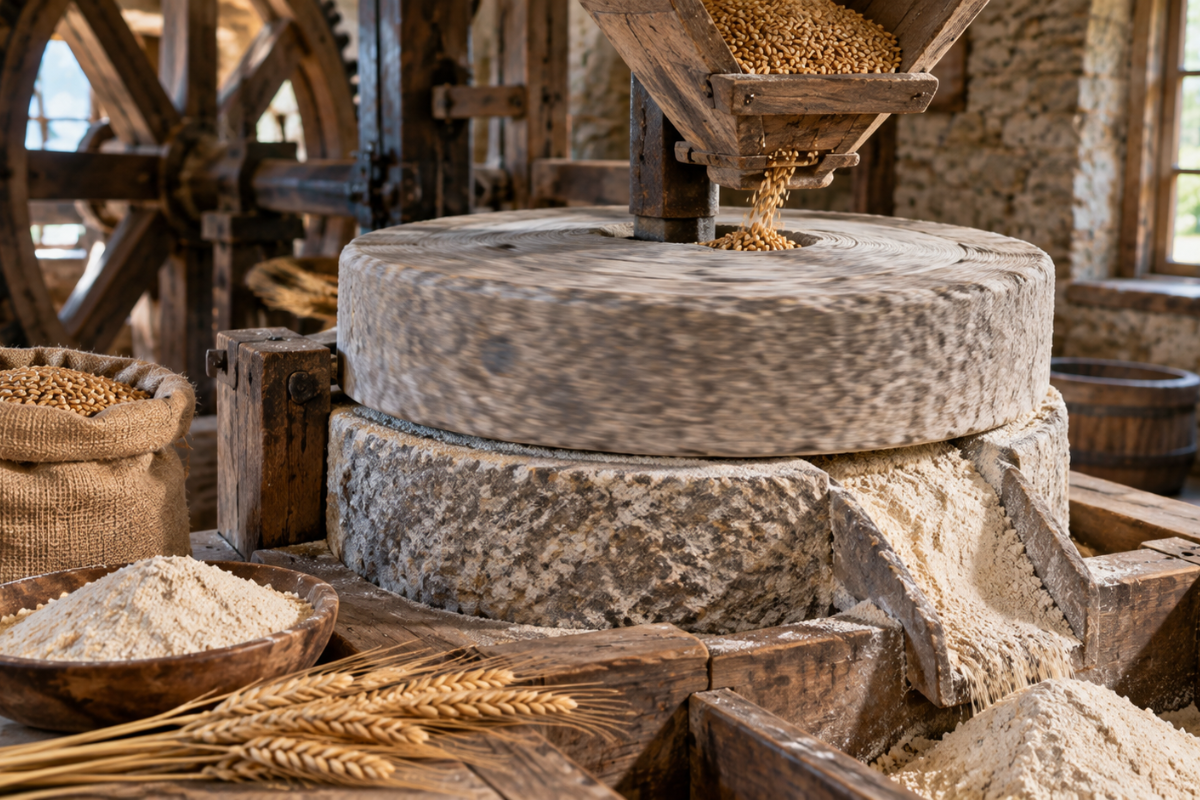
Stone millstones are traditional grinding stones used to crush and grind grains such as wheat, corn, and other cereals into flour or meal. They have been used for centuries in hand mills, watermills, windmills, and other types of grain mills. Unlike a single grinding stone, a traditional set of millstones works as a pair: one stone stays in place while the other rotates above it.
Although modern milling methods have changed the way most flour is produced, stone millstones remain important in traditional milling and are still used in some modern stone mills. Understanding their design, grinding action, maintenance, and history helps explain why these simple-looking stones played such an important role in food production.
What Stone Millstones Are and What They Are Used For
A stone millstone is a large, usually circular stone designed to grind grain. Traditional millstones are generally used as a pair. The lower stone is called the bedstone, and it remains stationary. The upper stone is the runner stone, which rotates over the bedstone. Grain enters through an opening near the center of the runner stone and is gradually moved outward as it is ground.
The main purpose of stone millstones is to reduce whole grains into smaller particles. Depending on the type of grain, the stone setting, and the milling process, the result can be flour, meal, or another ground grain product.
Historically, millstones were used to process important food grains, including wheat and corn. They were found in many different types of mills, with the power to turn the stones supplied by people, animals, water, wind, steam, or later electricity.
The Main Parts of a Stone Millstone
A traditional pair of stone millstones has several important features, each with a specific purpose.
The bedstone is the stationary lower stone. Its upper surface provides one side of the grinding area. Above it sits the runner stone, which rotates and does the moving part of the grinding.
The eye is the central opening in the runner stone. Grain is fed through this opening before entering the space between the stones.
The runner stone is supported and driven through a metal fitting commonly called a millrind or rynd. This connects the rotating stone to the spindle or shaft that provides its movement.
The working faces of both stones contain carefully arranged grooves. These grooves are not simply decorative cuts. They help move grain through the grinding area and contribute to the cutting and grinding action.
How Stone Millstones Grind Grain?
The grinding process begins when grain enters the eye of the rotating runner stone. It then moves between the runner and the stationary bedstone.
The two stone surfaces do not simply act like flat surfaces crushing grain. Their specially cut patterns create a shearing action as the runner rotates. The grain is progressively broken down as it travels from the center toward the outer edge of the stones.
The distance between the stones also matters. A miller could adjust the relationship between the runner and bedstone to control the grinding process. A smaller separation could produce a finer result, while a larger separation could produce a coarser meal.
Correct adjustment was important because excessive friction could generate unwanted heat. A skilled miller therefore needed to monitor the stones and the material coming from them while the mill was operating.
The Purpose of Furrows, Grooves, and Lands
The grooves cut into the working surfaces of stone millstones are called furrows. The flatter areas between the furrows are known as lands. Together, these features form the working pattern, or dress, of the stones.
Furrows perform several jobs. They help draw grain into and through the grinding area, provide cutting edges as the stones work against each other, and create channels through which the ground material can move toward the outside of the stones. They can also help air move through the grinding area and carry away some heat.
The arrangement of furrows must be carefully matched between the two stones. As the runner turns, the patterns work together to create the shearing action needed for effective grinding.
Common Stones and Materials Used for Millstones
Different types of stone have been used to make millstones. The choice depended on factors such as local availability, hardness, grain structure, and the type of milling being performed.
Buhrstone, including French buhrstone, became particularly well known for grain milling. Granite and other hard stones were also used in different regions and milling systems. Some traditional millstones were made from a single piece of stone, while others were constructed from multiple sections fitted together and secured with an iron band.
There is no single stone that is suitable for every historical or modern milling application. The characteristics of the stone and the way it is dressed both influence how effectively it performs.
How Millstones Are Dressed and Maintained?
Stone millstones gradually wear as they are used. Their furrows and lands lose the sharp, useful surfaces needed for efficient grinding. To restore them, millstones must be dressed.
Dressing involves working on the grinding faces to restore the correct grooves, lands, and overall surface. Historically, this was a skilled craft often performed by an experienced stone dresser. The runner stone had to be lifted away from the bedstone so its working face could be accessed.
Regular dressing was important because worn stones could become less effective. The exact frequency depended on factors such as the stone, the type and amount of grain being milled, and the condition of the grinding surfaces.
Stone Millstones in Traditional Grain Milling
Stone millstones were at the heart of many traditional grain mills. In a typical gristmill, grain was stored above or near the milling area and then fed into a hopper. From there, it was directed toward the eye of the runner stone.
As the runner rotated, the grain passed between the stones and was ground into meal or flour. The finished material moved toward the outside edge, where it could be collected and processed further.
Watermills and windmills provided important sources of mechanical power for these systems. This allowed millstones to process much greater quantities of grain than could be handled by simple hand grinding.
Stone-Ground Flour and the Milling Process
Stone-ground flour is produced by grinding grain with stones rather than relying on the roller-milling systems that became widespread during industrial milling.
In stone milling, the grain passes between the rotating runner and stationary bedstone. The stone surfaces break and grind the grain as it moves outward. The exact characteristics of the resulting flour depend on the grain, stone design, stone setting, and milling process.
Stone milling should not automatically be treated as meaning that every product has the same nutritional or culinary characteristics. Flour can differ considerably depending on how the grain is prepared, what parts of the grain are retained, and how the finished product is handled.
Stone Millstones Compared With Modern Milling Methods
Modern roller mills use a different approach from traditional stone millstones. Instead of grinding grain between two large stone surfaces, roller systems use pairs of rollers to break and reduce the grain through controlled stages.
Stone milling has advantages in traditional and small-scale applications, including its long-established method and distinctive equipment. Modern roller milling, however, allows large-scale flour production with highly controlled processing and separation.
The two methods should therefore be understood as different milling systems rather than assuming that one is always better for every purpose.
The Historical Role of Stone Millstones
The history of stone millstones reaches back thousands of years. Early forms of milling involved crushing grain between stones, while later mills developed more advanced arrangements using paired stones and mechanical power.
Over time, millstones became central to communities that depended on grain for food. Watermills and windmills allowed the grinding process to be powered by natural energy, while improvements in mill design increased the amount of grain that could be processed.
The development of industrial roller milling eventually changed commercial flour production in many places. Historical records show examples of mills replacing stone systems with roller mills during the nineteenth century.
Why Stone Millstones Are Still Used Today?
Stone millstones have not disappeared. They continue to be found in restored historic mills, working heritage sites, traditional milling operations, and some modern small-scale mills.
Part of their continued appeal comes from their connection to traditional milling. They also provide a practical way to demonstrate how grain was processed before modern industrial milling equipment became dominant.
For historic mills, keeping stone millstones operational can also help preserve traditional milling skills, including stone dressing and mill operation.
Choosing and Using Stone Millstones for Grain Grinding
Choosing stone millstones requires more than simply selecting a large piece of hard rock. The stone must be appropriate for the intended grain and milling system, while its grinding surface must be correctly prepared and maintained.
Important considerations include:
- The type of grain being milled
- The condition and material of the stones
- The design of the furrows and lands
- The ability to adjust the space between the stones
- Proper balance and alignment
- Regular inspection and dressing
Anyone operating traditional stone millstones also needs to understand that these are heavy, powerful pieces of equipment. Proper mill design, maintenance, and operating procedures are essential for safe use.
Conclusion
Stone millstones are much more than simple grinding stones. Their paired design, carefully cut furrows, adjustable grinding space, and regular maintenance allowed generations of millers to turn grain into useful flour and meal.
From early hand-operated mills to watermills and windmills, stone millstones played a major role in the development of grain milling. Although modern milling technology has changed commercial flour production, traditional stone milling remains an important part of milling history and continues in selected applications today.
Understanding how the runner stone, bedstone, furrows, lands, and dressing process work together provides a clear picture of why these remarkable stones remained useful for so long.
FAQs
What are stone millstones used for?
Stone millstones are primarily used to grind grains such as wheat and corn into flour or meal.
What is the difference between a bedstone and a runner stone?
The bedstone is the stationary lower stone. The runner stone is the upper stone that rotates during milling.
Why do millstones have grooves?
The grooves, or furrows, help create the grinding and shearing action, move grain through the stones, and direct the ground material toward the outer edge.
What does dressing a millstone mean?
Dressing means restoring or reshaping the working surface of a millstone, including its furrows and lands, so it can continue grinding effectively.
Are stone millstones still used?
Yes. They are still used in some traditional, heritage, and small-scale milling operations, although modern commercial milling commonly uses other systems.
